I'm transitioning my classes from the "Desire to Learn" (D2L) CMS to the ANGEL CMS. Unfortunately, I didn't export my classes before I lost access to D2L. Fortunately, I know a great person who was able to export the D2L files and send them to me.
Unfortunately, ANGEL doesn't recognize D2L files. Bummer.
All of my "Reading Quiz" questions are stored in a question bank which is an xml file. If I knew how to parse XML, I could probably cut and paste questions in to ANGEL.
I don't know how to parse XML, but I do know how to use Google. I found a bunch of tutorials, but ultimately settled on the Dive into Python tutorial.
My question bank had 2345 entries in it. The entries were made up of three things: a) the actual questions, b) multiple choice answers and distractors, and c) empty entries between questions. All the entries were identified with the 'mattext' tag, although there didn't seem to be an easy way to separate the various types of entries.
Here is some code I wrote. I'm putting it here so I don't lose it.
#!/usr/bin/env python
from xml.dom import minidom
xmldoc = minidom.parse('./questiondb.xml')
mattextlist = xmldoc.getElementsByTagName('mattext')
for i in range(2345):
#print i
try:
print mattextlist[i].firstChild.data
print "
\n"
except AttributeError:
print "
\n"
An AttributeError was triggered by every one of the empty entries. Printing the blank lines every time an empty entry was reached made the output of the script easier to interpret visually.
This was a fun little bit of python. I'm glad I was able to salvage stuff from the D2L class files.
August 22, 2011

August 11, 2011
After the Global Physics Department chat, I'm still very confused as to how the sig fig haters instruct their students to report numerical values.
I did a quick experiment measurement tonight: I measured the length and width of a sheet of printer paper in centimeters. I came up with \( l = 27.95\space \text{cm} \) and \( w = 21.60\space \text{cm} \). Each of the measurements I believed to be within \( \pm 0.05 \space \text{cm} \).
If I want to find the area, what value should I report? \( l \times w = 603.72 \space \text{cm}^2 \) without regard to the number of figures being reported.
Now, if I use the "crank three" method to get the range of values for the area, so that I can report the uncertainty in my area calculation, I would have:
$$l_{max} \times w_{max} = a_{max} = 605.1175\space \text{cm}^2 $$
$$l_{min} \times w_{min} = a_{min} = 601.245\space \text{cm}^2 $$
Then the uncertainty in the area calculation should be:
$$\Delta a = {a_{max} - a_{min} \over 2 } = 1.93625 \space \text{cm}^2 $$
Which means, that if I am a student just learning how to do this, I might report my answer as:
$$ 603.72 \space \text{cm}^2 \pm 1.93625 \space \text{cm}^2 $$
If I'm a really good student, I might remember that my instructor mentioned something about the uncertainty indicating how many digits should be reported in the answer. Maybe I even have in my notes a simple example from class. Hmmm, now I'm just confused. It seems like there should be a way to round my answer (both the value and the uncertainty) appropriately. But, how? (Remember, I'm still a beginning physics student.)
Here's my (the physics instructor, not the student, now) point: if you hate the rules or guidelines surrounding the traditional way of doing sig figs, that's fine with me. I'll even hop on that bus with you most of the way. But at some point, there has to be an actual discussion about the significance of the digits in the answers and the uncertainty. From there on out, we can choose whatever (appropriate) method we want for finding uncertainty, right?
If I want to find the area, what value should I report? \( l \times w = 603.72 \space \text{cm}^2 \) without regard to the number of figures being reported.
Now, if I use the "crank three" method to get the range of values for the area, so that I can report the uncertainty in my area calculation, I would have:
$$l_{max} \times w_{max} = a_{max} = 605.1175\space \text{cm}^2 $$
$$l_{min} \times w_{min} = a_{min} = 601.245\space \text{cm}^2 $$
Then the uncertainty in the area calculation should be:
$$\Delta a = {a_{max} - a_{min} \over 2 } = 1.93625 \space \text{cm}^2 $$
Which means, that if I am a student just learning how to do this, I might report my answer as:
$$ 603.72 \space \text{cm}^2 \pm 1.93625 \space \text{cm}^2 $$
If I'm a really good student, I might remember that my instructor mentioned something about the uncertainty indicating how many digits should be reported in the answer. Maybe I even have in my notes a simple example from class. Hmmm, now I'm just confused. It seems like there should be a way to round my answer (both the value and the uncertainty) appropriately. But, how? (Remember, I'm still a beginning physics student.)
Here's my (the physics instructor, not the student, now) point: if you hate the rules or guidelines surrounding the traditional way of doing sig figs, that's fine with me. I'll even hop on that bus with you most of the way. But at some point, there has to be an actual discussion about the significance of the digits in the answers and the uncertainty. From there on out, we can choose whatever (appropriate) method we want for finding uncertainty, right?
August 10, 2011
Significant figures are significant
Have you heard about the Global Physics Department Meetings? Physics teachers (high school and college) meet online every Wednesday night for about an hour to chat about a topic related to teaching physics.
This week the topic is about uncertainty, error propagation and significant figures. It seems that there is no shortage of physics teachers who are opposed to teaching about and requiring students to use significant figures.
Count me in the camp which thinks significant figures have a place in our classes and labs that we run.
Here's why:
The goal of a student getting a college degree in physics may not be to ultimately become a Ph. D. physicist (although that is a path that some physics majors start to pursue after graduation). But, there is a reasonable expectation that our students, once graduated, will be in a technical field of some sort that will require them to present data, calculations, results, whatever-you-want-to-call-it. In a word: numbers. (Oh, numbers with units, of course.) If a student graduates having never worked with significant figures, then writes a technical report for their employer with nonsensical data reporting it could reflect poorly on my department or the college and potentially negatively affect future applicants from our program.
I want my students to be thinking about the proper reporting of their numbers from the start of their physics career. I find that encouraging first-year student to wrestle with the idea of proper data reporting is easier than forcing juniors and seniors to have to go back to the concept of significant figures while they are undertaking more complicated laboratories and undergraduate research projects. If the concept of significant figures is already habit for them, it saves time and effort in the long run.
I tend to mostly agree with what Rhett said about significant figures in one of his posts, especially this part:
I've updated a handout that I give to some of my classes (usually general education astronomy classes, although sometime introductory physics classes as well) to emphasize that guidelines are only that: a guide. We should follow them when appropriate, but only when appropriate.
Here's the handout, if you're interested.
This week the topic is about uncertainty, error propagation and significant figures. It seems that there is no shortage of physics teachers who are opposed to teaching about and requiring students to use significant figures.
Count me in the camp which thinks significant figures have a place in our classes and labs that we run.
Here's why:
The goal of a student getting a college degree in physics may not be to ultimately become a Ph. D. physicist (although that is a path that some physics majors start to pursue after graduation). But, there is a reasonable expectation that our students, once graduated, will be in a technical field of some sort that will require them to present data, calculations, results, whatever-you-want-to-call-it. In a word: numbers. (Oh, numbers with units, of course.) If a student graduates having never worked with significant figures, then writes a technical report for their employer with nonsensical data reporting it could reflect poorly on my department or the college and potentially negatively affect future applicants from our program.
I want my students to be thinking about the proper reporting of their numbers from the start of their physics career. I find that encouraging first-year student to wrestle with the idea of proper data reporting is easier than forcing juniors and seniors to have to go back to the concept of significant figures while they are undertaking more complicated laboratories and undergraduate research projects. If the concept of significant figures is already habit for them, it saves time and effort in the long run.
I tend to mostly agree with what Rhett said about significant figures in one of his posts, especially this part:
I believe that many people (you know who you are) either treat significant figures as some fundamental truth, or they haven’t thought about them one way or the other. This is a huge problem when you are sig-fig-stickler.I'm not (I hope!) a sig-fig stickler. I want my students to be able to follow the general guidelines for using significant figures, but also have the critical thinking skills to be able to break the guidelines, where appropriate.
I've updated a handout that I give to some of my classes (usually general education astronomy classes, although sometime introductory physics classes as well) to emphasize that guidelines are only that: a guide. We should follow them when appropriate, but only when appropriate.
Here's the handout, if you're interested.
July 28, 2011

I love Fox Trot, as I suspect many physicists do. Bill Amend was a physics major in college and many of the Fox Trot strips have science themes and humor built in them.
When I saw the above strip recently, some questions came to mind:
What volume of tube is needed to provide the depicted motion in the strip?
If the estimated volume is not realistic, then what would the motion look like for a realistic volume for the tube?
Here's how I'm going to approach answering these questions: I'm going to model Jason's jump as a body in free-fall with an acceleration less than \(9.8 m/s^2\), and I'll determine the acceleration by estimating the buoyant force provided by the tube.
The first thing I want to do is draw a free body diagram. Consider a spherical Jason:

So let's look at what we have (yes, the forces are vectors, but it's in one dimension and the vector notation isn't looking so great here right now):
$$ W = M g$$
$$ B = \rho_{air} V g$$
where \(V\) is the volume of the tube. Now let's apply Newton's second law:
$$ F_{net} = M a = B - W = \rho_{air} V g - M g$$
Okay, now that I have a free body diagram and the application of Newton's second law let me think for a second about what I wanted to know.
I wanted to know the volume of the tube required to produce the depicted motion. So, I need to estimate something reasonable for what motion is being depicted. I'm going to make some assumptions:
- The height of the springboard is 3 meters.
- Based on that height, I'm estimating that Jason falls 2.0 meters from the board. (Two sig figs? No, not really, but I want two digits in my solution.)
- I'll neglect the small upward jump at the beginning. It looks small and maybe he is simply pulling his legs up which makes the upward part of the trajectory more obvious. With this assumption the initial velocity will be zero.
- I'll estimate Jason's mass to be 30 kg. (I don't need it now, but I'll put it here with all my other assumptions.) I'm also assuming the tube's mass is negligible.
- The air density is \(1.2 kg/m^3\) based on the temperature of a hot summer day.
- The important question is what is the time interval being depicted. I'm going to take a cue from the artist and guess that since there are seven panels depicted after the jump, the time interval is roughly seven times longer than it would have been without the jump. Is that reasonable? I don't know, but it's my interpretation of the comic.
$$\Delta y = {1 \over 2} g t^2$$
Since I assumed that the time interval is going to be 7 times longer than without the tube, I should find what the time to fall 2 meters is without the tube. In this case \(g= 9.8\: m/s^2\):
$$t = \sqrt{ 2 \Delta y \over g} = \sqrt{4 m \over 9.8 m/s^2}= 0.64\: s$$
So the length of the fall with the tube would be \(7 \times 0.64 s = 4.5\: s\). With that time, I want to solve for the acceleration with the tube:
$$a = 2\Delta y \over t^2 = 4.0 m \over (4.5 s)^2 = 0.2\: m/s^2$$
That's a pretty low acceleration. Cool, now I can solve for the volume of the tube:
$${a \over g}M + M = \rho_{air} V$$
Solving for \(V\):
$$V = 26\: m^3$$
Hmm...is that big? Yes it is. I have one of the jumbo sized hoberman spheres that I bring in to class to show what one cubic meter is. There is no what the tube has that large of a volume. Okay, then what would the acceleration (and the time of the fall) be if the tube has a realistic volume. Let's estimate the volume to be around \(1.0\: m^3\). So that means the acceleration Jason will experience is:
$$a = ({\rho_{air} V - M \over M}) g$$
which for our estimated tube volume gives an acceleration of \( 0.96\: g\ = 9.4\: m/s^2\). The time to fall 2 meters at this acceleration is 0.65 seconds. (Now you see why I wanted 2 sig figs?)
Note that the change in acceleration is linear with changing tube volume, but that the time for falling a given distance is NOT linear. I'd go into that more, but this has already taken me longer to write than I was intending.
July 10, 2011
Acoustics link dump - July 2011 version
My browser tabs are again full of links that I haven't fully digested. I need a place to file them, so I'm putting them here so I can hope to remember them for future reference.
Equation behind noise canceling headphones - probably over-simplified, but neat to see on Wired nonetheless.
Tibetan singing bowls - this was all over physics/science/tech blogs this week. It's interesting, but not so much for the acoustics and/or the videos. The fluid dynamics presented in the paper is the really interesting stuff here.
Earliest known recording discovered - very cool story, more links from the metafilter post on the topic.
Demo of Air Temperature on Wind Instrument Tuning - Here's something you can use in a classroom demo. Simple and elegant.
Equation behind noise canceling headphones - probably over-simplified, but neat to see on Wired nonetheless.
Tibetan singing bowls - this was all over physics/science/tech blogs this week. It's interesting, but not so much for the acoustics and/or the videos. The fluid dynamics presented in the paper is the really interesting stuff here.
Earliest known recording discovered - very cool story, more links from the metafilter post on the topic.
Demo of Air Temperature on Wind Instrument Tuning - Here's something you can use in a classroom demo. Simple and elegant.
June 23, 2011
Summer is the time for tenderloins
I ran into another physics professor (at the college down the street from where I live) at the awesome Naf Naf Grill a couple months ago. We got to talking, and it turns out that he has a really cool map of all the places to get tenderloins in Iowa.
This made me think of Porky's in Des Moines, which was across the street from the grocery store I worked at during high school. Unfortunately, Porky's is no more. Too bad, since the cruise nights were always a lot of fun.
I did find a new blog to follow: Des Loines. Their tagline is beautiful. "The Breaded Pork Tenderloin Sandwich: It's like the filet-mignon cut of pork, deep fried to perfection."
This made me think of Porky's in Des Moines, which was across the street from the grocery store I worked at during high school. Unfortunately, Porky's is no more. Too bad, since the cruise nights were always a lot of fun.
I did find a new blog to follow: Des Loines. Their tagline is beautiful. "The Breaded Pork Tenderloin Sandwich: It's like the filet-mignon cut of pork, deep fried to perfection."
June 22, 2011
Venturi pumps, injectors, ejectors and eductors
We've had some severe weather blow through our area recently, and I've been thinking a lot about backup sump pumps. It turns out that there is a lot of interesting physics in backup sump pumps.
It also turns out that the interesting physics is not as simple as I was hoping it would be.
This is a backup pump which requires no power (battery or otherwise) because it uses the Venturi effect to pull water out of the sump well. That sounded really interesting to me, so I sat down this morning and tried playing around with the Bernoulli equation and the continuity equation to see if I could come up with some interesting questions to ask my intro physics class next time we do fluid mechanics.
After struggling for five hours, and not coming up with anything remotely looking physically possible (47 meter pump extraction height? negative water pressure?), I've come to the conclusion that an intro level analysis (even making typical assumptions) is not possible.
After much searching through reference databases, I'm not sure I've even located a decent analysis of these pumps at an advanced level.
Since this pump is simple to conceptually understand, I'm having trouble figuring out why I can't locate a decent reference with the physics of how it works. If anyone has seen anything on this, please let me know.
It also turns out that the interesting physics is not as simple as I was hoping it would be.
This is a backup pump which requires no power (battery or otherwise) because it uses the Venturi effect to pull water out of the sump well. That sounded really interesting to me, so I sat down this morning and tried playing around with the Bernoulli equation and the continuity equation to see if I could come up with some interesting questions to ask my intro physics class next time we do fluid mechanics.
After struggling for five hours, and not coming up with anything remotely looking physically possible (47 meter pump extraction height? negative water pressure?), I've come to the conclusion that an intro level analysis (even making typical assumptions) is not possible.
After much searching through reference databases, I'm not sure I've even located a decent analysis of these pumps at an advanced level.
Since this pump is simple to conceptually understand, I'm having trouble figuring out why I can't locate a decent reference with the physics of how it works. If anyone has seen anything on this, please let me know.
June 20, 2011
Year end reflections
This year was a real struggle for me in teaching the introductory physics (algebra based) sequence. I think there were some successes with what some of the students got out of the class, but I couldn't honestly say that I was satisfied with how the class, in general turned out.
There is no single thing that I can identify that went wrong with the class. A whole bunch of things just lined up to make the classes what they were. Some things were in my control, and I could have done a better job with, some things were out of my hand.
I can't rank the order in which these factors played a part of the result of the class, but here are some of the things I want to remember so that I can use them in the future.
There is no single thing that I can identify that went wrong with the class. A whole bunch of things just lined up to make the classes what they were. Some things were in my control, and I could have done a better job with, some things were out of my hand.
I can't rank the order in which these factors played a part of the result of the class, but here are some of the things I want to remember so that I can use them in the future.
- Class size
Our algebra-based intro physics sequence is made up of 2 sections (I taught one of the sections in Fall and Winter, and both in the Spring) nominally capped at 48 students. The cap has to do with the lab space, but there was a scheduling goof-up which opened up an extra lab period in each section, so with some creative schedule-shifting we were able to enroll an extra 5-6 students in each section. The classroom only has 60 seats, so in a way, that would have been the hard cap for the class.
It became obvious to me, only after the Fall quarter ended, that perhaps 48 students was too many in a section where I was trying to have them interactively engaged heavily with the material. Try as I might to walk around and get them going on working on questions or examples, I could never get around to enough of the groups to get them going on it to their satisfaction. Add to that the overwhelming attitude of "I-have-no-idea-where-to-start-so-I'm-not-even-going-to-try" which pervaded the class made it a tough row to hoe for me from the get go.
The Winter Quarter I had a much smaller class, as many students decided they hated my style. I think I had better success in the Winter Quarter with the smaller section, but I was still trying to win over a few students who were in my section only because they couldn't get into the other. (Which they anonymously told me on their evaluations from the Fall Quarter.) By the Spring Quarter (when I had a large section and a small section, and the students had no choice but to have me) it was obvious that the smaller section was more in tune to what was going on in class, more receptive to the interactive engagement, and to a certain degree more interested in actually learning the material.
- Class dynamics
I suppose it's a bit of a cop-out to try to blame the difficulties I experienced this year on something so intangible as the dynamic interaction between the class and me and the interactions between the students. But, this past year there was ALWAYS something lingering in the background, even before the class had decided they didn't like my teaching. My colleague teaching the other section described it as if the students were acting like it was us (the instructors) versus them (the students) in some sort of contest. Of course, we (the instructors) see the introductory physics course as a journey that everyone (instructors and students) are taking together. I made an effort at the start of the year to try to put the class at ease, but that lingering feeling of us-vs-them never completely left.
At least one of the students in the larger section this past quarter identified my unease with the situation. The student commented that I let the other student's attitude affect me and the way I was teaching. There is certainly truth to that. It was really hard going into class every other day and knowing that many of the students who even bother to show up have already decided that whatever I'm going to do that day is total crap. I was trying to balance that with actually delivering a class based on Physics-Education-Research (PER) driven methods of teaching.
One of the points that one of my colleagues in the department had made to me was that my courses were made up of junior and senior level biology majors (primarily) who have been in lecture-only classes for the past 3-4 years. It's the only way they think they know how to learn. I tried desperately to adjust my teaching style to match the student's comfort level while retaining the spirit of interactive engagement, but that message seemed not to be received by most students in the class.
I talked to a colleague of mine at a conference I went to this Spring about his classes. Before I had a chance to tell him about my classes he was telling me how he was really unhappy with the class dynamics in his courses he was teaching. I don't think this is a signal of a larger problem with students today. Rather, I think (hope?) that occasionally you get a class that for whatever reasons just doesn't work well with you as an instructor.
- First day
One of the lessons I had thought I had learned last year was to make my expectations for how the class would go very clear on the first day. I thought I had done a good job of that, but I think I can do even better. I am going to try to present actual PER data to my class next time to try to explain the motivation for the methods that we use.
- Organization
I get many comments on the course evaluations about how disorganized the class seems. I think what that means is "Professor does not provide line-by-line notes for me to copy" because most of the other ways that students have asked for organization I have implemented.
The one way in which I think I could really improve the organization of the class is if I classified what goes on the board. I often have a "mini-lecture" prepared to go along with a clicker question. Sometimes I even have examples prepared (see next item for more on example) to show to the class. What I need to do is better show the distinction between the two. If I start the "mini-lecture" with the word "Theory" on the board (and underline it) then when I get to the example write "Example" on the board, I think it will cue the students a bit better. It seems like a simple change that I can try to see whether it helps or not.
- The role of "examples" - asking WHY we do a particular problem
I don't really believe in doing too many examples in class. I mean, I don't believe that *I* should do examples in class. I already know how to do the problem. What good does it do to show students how to do the problem? They won't retain the understanding of how to work the example unless they do it themselves.
I've explained that philosophy to students, and it has mostly been rejected by all of the classes who have heard me explain it. They always want more examples. The issue, they tell me, is that if they have not seen any examples worked by me on the board, then they have no idea how to start a problem that I give them in class to work. I had one class where (after they asked me to do more examples) I did an example and then gave the class a problem to work on their own in class and they STILL claimed that they had no idea how to start the problem. What good, then, did the example that I did for the class do for them? It ate up about 10 minutes of class time. But they FELT BETTER about trying my problem on their own. I don't know how I feel about this. If I can get the students to be more receptive to interactive engagement by taking a bit of time out to be less engaging, maybe it's not so bad.
What I do know is that I need to get better at asking students to consider why we work out a particular example or homework problem. "What did you learn by doing this?" should be a required part of the homework and example-working process.
- Student responsibility
Finally, I think that there was a large lack of personal responsibility for learning exhibited by the students in my classes this year. Many of my students go to school full time and work full time or nearly full time. Many students all over do the same. It is never easy. But, I was surprised by the attitudes of these students who somehow expected me to adjust my expectations of them based on their work schedule. I heard comments in the halls (when it was believed that I was out of earshot) that I should not expect them to come to my office ever for help or send email if they needed a hint on the homework. One student claimed that everything he needed to know should be covered in class, since he worked full time he could not be expected to ever come to my office. I agree that all the concepts needed to complete the homework should be covered in class, which they were. But there is NO WAY that I would expect that every student would UNDERSTAND the concepts deep enough to solve all the homework problems without asking for help.
At least that student was trying to do the homework. Many of the students gave up on doing homework and a number gave up on coming to class. I changed the schedule for the last quarter so that every week they had an hour long "workshop" where no new content was presented, but the class would have the opportunity to review all the concepts we had covered that week. It actually gave the class a net increase of 45 minutes (much of which was used for working examples and homework problems) of class time per week. (15 minutes was taken out of one class period each week for a quiz, thus a one hour workshop leads to 45 minute net increase in class time.) Yet, the workshops were consistently skipped by many students.
May 18, 2011
Random links worth reading
Hyperbole and a Half: The Alot is Better Than You at Everything
Think Thank Thunk - My First Conference: Wisconsin Math Council (SBG):
Think Thank Thunk - The Grading Dilemma: What’s Effort Worth?:
Free/Libre Open Source Science Education: Learning by Doing and Failing
Physics Buzz: Phriday Fizzicts Phun! (May be offensive?)
Think Thank Thunk - My First Conference: Wisconsin Math Council (SBG):
Think Thank Thunk - The Grading Dilemma: What’s Effort Worth?:
Free/Libre Open Source Science Education: Learning by Doing and Failing
Physics Buzz: Phriday Fizzicts Phun! (May be offensive?)
April 11, 2011
CC-licensed physics artwork
 I'm putting my collection of physics drawings that I've been constructing for the past few years online here for physics teachers to download and use in their classes. There's not a lot to the collection, yet, but I hope it continues to grow.
The files were constructed in OpenOffice Draw. I don't know what programs can be used to open these files, other than OpenOffice Draw and its relatives.
 I'm (obviously) not a graphic designer. I'm not claiming these are great pieces of artwork, but I am putting them online and using a Creative Commons license for use. I hope that some of you out there who see these drawing will find them to be useful and that maybe some of you would be interested in helping to build the collection and improve the images.
Physics Drawings - Thermodynamics
Physics Drawings - Electrostatics 1
Physics Drawings - Electrostatics 2
Physics Drawings - DC circuits
Physics Drawings - Racetrack

This work by Andrew Morrison is licensed under a Creative Commons Attribution-NonCommercial-ShareAlike 3.0 Unported License.
April 06, 2011
Mythbusters need to spin more science
I want to like this segment that the Mythbusters did on the merry-go-round spun by the bullet. I think it's an interesting question based off of a scene from a movie: Is there enough kinetic energy in a bullet to spin a merry-go-round.
A proper analysis of the question could involve kinetic energy, rotational kinetic energy, torque, angular speed, angular acceleration, angular momentum, friction, air resistance and potentially other factors.
The Mythbusters only vaguely waved their hands at some of these ideas and presented physical parameters in weird units.
The voice over in the above video said "First, the science of spin..." then proceeded to say very little about rotational motion.
Grant talks about how the bullet has to "overcome inertia". Okay....I mean, we tell physics students that in rotational motion it is the moment of inertia that matters, but I'm willing to let it slide. EXCEPT, he then pulls out a force gauge and measures how much force is needed to just get the merry-go-round to move. But, since we care about the rotation of the merry-go-round, it's the torque that matters. Plus, what he really is getting at is a measure of the coefficient of static (rotational) friction on the axle.
There were a lot of other problems with the things the Mythbusters said in the segment. Some of what they said was just using colloquial terms for physical properties which a physicists would not use. I'm not so terribly upset by those comments. I'm just bothered by the lack of coherent explanation of the physics of the system. I came up with a simple analysis of the experiment, using parameters provided in the video and considering just conservation of momentum. I don't claim it to be a full treatment of the question, just more of a back of the envelope type calculation. (And I don't take friction into account, either.)
I turned my calculation into a pencast:
Analysis of Mythbusters merry-go-round question
April 02, 2011
Links from my ISAAPT talk
I gave a talk last weekend at the Illinois Section AAPT Spring 2011 meeting called "What Physics Teaching Blogs Are You Reading?" (You'll have to scroll to the bottom of that page to see the abstract.)
I'm putting the presentation online here, in case anyone wants to check it out. What I said in my talk was that maybe I should have titled it "What Physics Teaching Blogs Am I Reading?" since it is a subset of some of the blogs I subscribe to in Google Reader. The presentation has for each blog I chose: the name of the blog, the URL, a partial description of the blogger or the blog (copied from the blog itself) and a couple of particularly interesting posts that I picked out. That's all there was to the presentation.
My ISAAPT Spring 2011 presentation
If all you want are the links to the blogs, I put them together in one convenient bundle here:
All the physics teaching blogs I'm currently reading.
I'm putting the presentation online here, in case anyone wants to check it out. What I said in my talk was that maybe I should have titled it "What Physics Teaching Blogs Am I Reading?" since it is a subset of some of the blogs I subscribe to in Google Reader. The presentation has for each blog I chose: the name of the blog, the URL, a partial description of the blogger or the blog (copied from the blog itself) and a couple of particularly interesting posts that I picked out. That's all there was to the presentation.
My ISAAPT Spring 2011 presentation
If all you want are the links to the blogs, I put them together in one convenient bundle here:
All the physics teaching blogs I'm currently reading.
March 21, 2011
All charged up
I've spent about 3 hours today thinking about the electric field created by two like charges. I didn't spend all that time thinking about it because it's a particularly interesting topic, nor is it terribly hard for me to envision.
I spent the time thinking about it because I want a good image of the field that is a.) useful for my students and b.) available for me to use without bending any copyright laws. I've been mostly generating my own artwork for classes (with the side goal of creating a CreativeCommons licensed library for people to make use of) but creating an electric field diagram isn't something that can easily be whipped up in a drawing program.
After quite a bit of searching for images labeled for reuse, I happened to find a python program that can be used to create vector field plots of various electromagnetic configurations. Awesome, right? I even found an example code of the field that is generated by one positive and one negative charge.
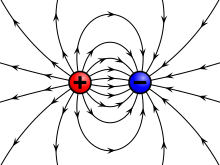
What I wanted was the field around a set of like charges, but I can read source code and figure out how to change a negative sign, right? Wrong. I need to spare myself the embarrassment of posting my attempts to correctly plot the field, but know that it went from bad to worse.
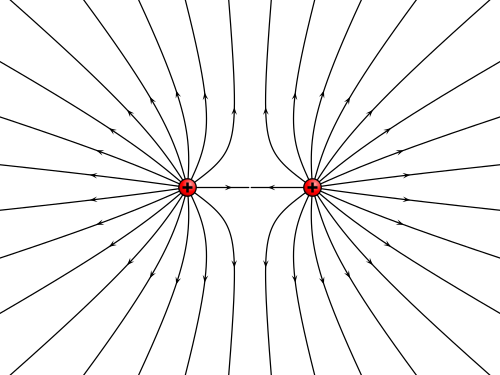
Not willing to give up, I went back to wikimedia and found every uploaded image which had been made using this program. Fortunately, this included the charge configuration I was looking for:
I spent the time thinking about it because I want a good image of the field that is a.) useful for my students and b.) available for me to use without bending any copyright laws. I've been mostly generating my own artwork for classes (with the side goal of creating a CreativeCommons licensed library for people to make use of) but creating an electric field diagram isn't something that can easily be whipped up in a drawing program.
After quite a bit of searching for images labeled for reuse, I happened to find a python program that can be used to create vector field plots of various electromagnetic configurations. Awesome, right? I even found an example code of the field that is generated by one positive and one negative charge.
What I wanted was the field around a set of like charges, but I can read source code and figure out how to change a negative sign, right? Wrong. I need to spare myself the embarrassment of posting my attempts to correctly plot the field, but know that it went from bad to worse.
Not willing to give up, I went back to wikimedia and found every uploaded image which had been made using this program. Fortunately, this included the charge configuration I was looking for:

Unfortunately, I wasn't too thrilled with the horizontally oriented field line right in between the two charges. The electric field is zero at a point equidistant from the two (identical) charges. And while, the arrows are pointing in opposite directions along this line, I'm not sure if it is obvious to my students that the electric field at that point is zero.
(Side note: I'm starting to see why Randy Knight uses vector field plots, instead of electric field lines. We're not using the Knight textbook, and these drawings are my attempt to bridge the gap between the two representations and hopefully make things more understandable.)
What I'm going to do, unless I come up with something I like better, is use this image instead:

(Side note: I'm starting to see why Randy Knight uses vector field plots, instead of electric field lines. We're not using the Knight textbook, and these drawings are my attempt to bridge the gap between the two representations and hopefully make things more understandable.)
What I'm going to do, unless I come up with something I like better, is use this image instead:

Gone is the electric field line in the middle and added are more vectors. It's not perfect, but I'm not sure I can spend more time finding the perfect representation anymore.
March 19, 2011

 Cubicle Warfare: 101 Office Traps and Pranks by John Austin
My rating: 3 of 5 stars
Like most books that are a list of pranks and practical jokes, this is a really quick read. While it had a few offensive (and possibly illegal?) suggested practical jokes, most of them were good natured and harmless office stunts. I got a few good laughs from some of the suggested pranks. It is a better book than some of the other similar books on pranks, but overall I was a bit disappointed with it.
March 18, 2011
What I learned about teaching this quarter
Another quarter has come and gone already. At the end of each term, I like to look back at what I've tried to do in the class and figure out what worked, what didn't work, and what I can do to improve for the next quarter.
What worked:
"Reading Quizzes" due at 8:00 am every day of class. Okay, I'm still not convinced that the students are actually reading the text as much as I want them to, nor do I necessarily like calling them "Reading Quizzes" but I do get great information about what is generally the most confusing aspects of the material that we are going to cover.
I'm going to try to improve these by off-loading some of the clicker questions onto the "Reading Quizzes" in an attempt to make students confront their misconceptions and gaps in understanding.
What didn't work so well:
The Interactive Lecture Demonstrations were not as effective as I had hoped. They took too much time and the payoff wasn't what I was hoping for. I may try a few more, but I'm also thinking that I need to attend one of their workshops to see how to do them better in class.
What I learned:
I had a rough Fall quarter. At the end of that quarter I felt that I knew less about teaching than I did at the start of the quarter. Part of the reason I reflect on what I've learned about teaching each quarter is an attempt to get better at teaching. Before last Fall, every single term I had taught I felt like I was carrying forward lessons which I had learned and was therefore becoming a better teacher. But my Fall quarter was pretty much the opposite of everything I had ever before experienced. Strategies which worked well in the past crashed and burned. Students were frustrating and became closed to trying new ways of learning. I tried adapting, I really did, but in the end I felt like the students and I were just surviving the class and each other.
This past quarter was a much better experience. True, the classes were smaller, probably in part due to the students wanting to get as far away from a bad teacher as possible. The students who remained were more willing to engage in the material and I feel that the class got deeper into the material this quarter than last.
I hadn't changed much in the way of what I was doing in class. There were a few minor tweaks here and there, but overall the class was largely the same experience. As this Winter quarter was drawing to an end I was trying to figure out what I had learned about teaching that would carry forward to next quarter. It was then that I realized the main difference between the two quarters was that somehow I had connected with the students in the Winter in a way that I had not in the Fall.
I'm still not sure what the difference was in HOW I connected with these students. The point is that, when there was no connection, the class was disengaged and uninterested in learning. The more connected I felt to the class, the more willing to engage with the material they seemed to be.
It seems so obvious now that it is almost silly that I had to learn this lesson for myself. I know in previous environments I've been in it has been easier to connect with students. I don't know why it was harder last Fall, and in a sense it doesn't really matter. I just need to remember to be cognizant of how the class is getting along with me so that we can't concentrate on learning.
What worked:
"Reading Quizzes" due at 8:00 am every day of class. Okay, I'm still not convinced that the students are actually reading the text as much as I want them to, nor do I necessarily like calling them "Reading Quizzes" but I do get great information about what is generally the most confusing aspects of the material that we are going to cover.
I'm going to try to improve these by off-loading some of the clicker questions onto the "Reading Quizzes" in an attempt to make students confront their misconceptions and gaps in understanding.
What didn't work so well:
The Interactive Lecture Demonstrations were not as effective as I had hoped. They took too much time and the payoff wasn't what I was hoping for. I may try a few more, but I'm also thinking that I need to attend one of their workshops to see how to do them better in class.
What I learned:
I had a rough Fall quarter. At the end of that quarter I felt that I knew less about teaching than I did at the start of the quarter. Part of the reason I reflect on what I've learned about teaching each quarter is an attempt to get better at teaching. Before last Fall, every single term I had taught I felt like I was carrying forward lessons which I had learned and was therefore becoming a better teacher. But my Fall quarter was pretty much the opposite of everything I had ever before experienced. Strategies which worked well in the past crashed and burned. Students were frustrating and became closed to trying new ways of learning. I tried adapting, I really did, but in the end I felt like the students and I were just surviving the class and each other.
This past quarter was a much better experience. True, the classes were smaller, probably in part due to the students wanting to get as far away from a bad teacher as possible. The students who remained were more willing to engage in the material and I feel that the class got deeper into the material this quarter than last.
I hadn't changed much in the way of what I was doing in class. There were a few minor tweaks here and there, but overall the class was largely the same experience. As this Winter quarter was drawing to an end I was trying to figure out what I had learned about teaching that would carry forward to next quarter. It was then that I realized the main difference between the two quarters was that somehow I had connected with the students in the Winter in a way that I had not in the Fall.
I'm still not sure what the difference was in HOW I connected with these students. The point is that, when there was no connection, the class was disengaged and uninterested in learning. The more connected I felt to the class, the more willing to engage with the material they seemed to be.
It seems so obvious now that it is almost silly that I had to learn this lesson for myself. I know in previous environments I've been in it has been easier to connect with students. I don't know why it was harder last Fall, and in a sense it doesn't really matter. I just need to remember to be cognizant of how the class is getting along with me so that we can't concentrate on learning.
March 17, 2011

March 09, 2011

March 07, 2011
Adopting the "growth" mindset
I just finished reading Mindset: The New Psychology of Success by Carol Dweck. It has changed a lot about how I think about learning and personal growth in my life (both professionally and otherwise). I'm trying to implement the idea of having a "growth" mindset in all I do for my classes and my research. It's hard work, but I guess that's part of the point.
If there was only one thing I could implement in my classes from the book, it would be the following passage from chapter 3:
Robert Talbert recently asked about the responsibilities of students and instructors in college. I don't know if I have a set answer to his question, but I do believe that if students are willing to put in the effort to do the work that I ask them to do in my class, then it is my responsibility to provide whatever assistance they need to be successful in learning the content in my class.
by Carol Dweck. It has changed a lot about how I think about learning and personal growth in my life (both professionally and otherwise). I'm trying to implement the idea of having a "growth" mindset in all I do for my classes and my research. It's hard work, but I guess that's part of the point.If there was only one thing I could implement in my classes from the book, it would be the following passage from chapter 3:
How teachers put a growth mindset into practice is the topic of a later chapter, but here's a preview of how Marva Collins, the renowned teacher, did it. On the first day of class, she approached Freddie, a left-back second grader, who wanted no part of school. "Come on, peach," she said to him, cupping his face in her hands, "we have work to do. You can't just sit in a street and grown smart....I promise, you are going to do, and you are going to produce. I am not going to let you fail."
Robert Talbert recently asked about the responsibilities of students and instructors in college. I don't know if I have a set answer to his question, but I do believe that if students are willing to put in the effort to do the work that I ask them to do in my class, then it is my responsibility to provide whatever assistance they need to be successful in learning the content in my class.
March 06, 2011
You've seen the videos that Vi Hart has been producing featuring what she calls doodle games related to various topics in math, right? They made the rounds of the science and physics blogs towards the end of last year and beginning of this year.
Here's one of the most popular videos, in case you haven't seen it:
I don't want to sound too critical of what this woman has produced. In fact, I really like her series of videos. (Plus, she makes homemade musical instruments. How cool is that?)
But, here's what you might not know about Vi Hart: her father is George Hart, a former professor at Stony Brook University, a sculptor, and the first director of the soon-to-open Museum of Mathematics.
What that means to me is that Vi grew up in an environment where curiosity about mathematics was nurtured and developed. It also indicates to me that she has been working for a long time to develop her talents. Those last two points are not criticisms, they are merely observations.
I do take issue with her underlying commentary on the state of math education (and really, school in general) which is that classes are boring and taught by incompetent teachers, and that students would get more out of class by not paying attention and just playing some doodle games. I'm not even sure I disagree with her (completely) on those points, either. What I disagree with is the notion that anyone learns anything from watching her videos. She talks too fast for most people to be able to maintain comprehension all the way through the video and there are many terms which are unfamiliar to non-mathematicians which fly by as the video is playing.
I wanted to better understand what the doodle games were all about, so the first thing I did was I tried creating some doodles on my own. (If her only goal in these videos is to get people to try out the doodles, then maybe they are working better than I give her credit for.) I was able to follow the first two doodle games in the above video, but I wasn't able to get the shading right on the third doodle game. More frustrating to me was that I couldn't really understand the importance of the doodles. In the video she mentioned knot theory and weaving but I could never quite catch what it was she was actually saying about all of that.
I went looking for a transcript of the video, but I couldn't find one. So, I sat down at my computer and banged out a transcript myself. I learned a few things by doing that. One, I learned that one of the figures she mentioned in the video is called a Ouroboros. I had no idea what she was talking about when I had watched the video, but by piecing together the transcript I was able to get the correct spelling and look it up online.
After I had the transcript complete, I started looking into all the topics she mentioned in the video. My digging eventually turned into this post at metafilter which was well received by the community over there. In finding the links which went into the post, I was able to dig a little into topics like knot theory and topology which I had previously known next to nothing about. I definitely appreciate that the video brought these ideas to my attention so that I would be inspired to learn more about them.
The thing is, though, it took a lot of my time to read up on those topics. I was constructing the metafilter post for over 2 weeks, working an hour or two every night in my free time. I learned a lot because I put in the effort to do so. I'm willing to bet that Vi Hart has put in thousands of hours of study to cultivate her passion and talent for math. It seems a little disingenuous to me, then, that she puts together videos with the attitude of "classes are boring" and "students don't need to pay attention". For a lot of students, classes are their only chance to engage with topics such as math or science. Most people aren't fortunate enough to have a parent who is a professional scientist or mathematician. It might not appeal to adults who feel they suffered through boring classes in their school years, but how many more kids could she encourage to engage more in their classes if her videos said something like: "Hey, ask your teacher in class about this. If you show interest in it, your teachers will likely respond to that interest!"
But, more importantly, it would be great to remind students that learning takes work. You don't become an expert on graph theory just because you've watched a four minute video on doodles. This is something I know, but I have to constantly remind myself of anyway. If I really wanted to make the third doodle game work, I could do it, but I would have to put in the effort and time to be able to do it. Vi Hart's videos not only miss the opportunity to encourage students to think that way, they might be inadvertently sending students the exact opposite message.
Here's one of the most popular videos, in case you haven't seen it:
I don't want to sound too critical of what this woman has produced. In fact, I really like her series of videos. (Plus, she makes homemade musical instruments. How cool is that?)
But, here's what you might not know about Vi Hart: her father is George Hart, a former professor at Stony Brook University, a sculptor, and the first director of the soon-to-open Museum of Mathematics.
What that means to me is that Vi grew up in an environment where curiosity about mathematics was nurtured and developed. It also indicates to me that she has been working for a long time to develop her talents. Those last two points are not criticisms, they are merely observations.
I do take issue with her underlying commentary on the state of math education (and really, school in general) which is that classes are boring and taught by incompetent teachers, and that students would get more out of class by not paying attention and just playing some doodle games. I'm not even sure I disagree with her (completely) on those points, either. What I disagree with is the notion that anyone learns anything from watching her videos. She talks too fast for most people to be able to maintain comprehension all the way through the video and there are many terms which are unfamiliar to non-mathematicians which fly by as the video is playing.
I wanted to better understand what the doodle games were all about, so the first thing I did was I tried creating some doodles on my own. (If her only goal in these videos is to get people to try out the doodles, then maybe they are working better than I give her credit for.) I was able to follow the first two doodle games in the above video, but I wasn't able to get the shading right on the third doodle game. More frustrating to me was that I couldn't really understand the importance of the doodles. In the video she mentioned knot theory and weaving but I could never quite catch what it was she was actually saying about all of that.
I went looking for a transcript of the video, but I couldn't find one. So, I sat down at my computer and banged out a transcript myself. I learned a few things by doing that. One, I learned that one of the figures she mentioned in the video is called a Ouroboros. I had no idea what she was talking about when I had watched the video, but by piecing together the transcript I was able to get the correct spelling and look it up online.
After I had the transcript complete, I started looking into all the topics she mentioned in the video. My digging eventually turned into this post at metafilter which was well received by the community over there. In finding the links which went into the post, I was able to dig a little into topics like knot theory and topology which I had previously known next to nothing about. I definitely appreciate that the video brought these ideas to my attention so that I would be inspired to learn more about them.
The thing is, though, it took a lot of my time to read up on those topics. I was constructing the metafilter post for over 2 weeks, working an hour or two every night in my free time. I learned a lot because I put in the effort to do so. I'm willing to bet that Vi Hart has put in thousands of hours of study to cultivate her passion and talent for math. It seems a little disingenuous to me, then, that she puts together videos with the attitude of "classes are boring" and "students don't need to pay attention". For a lot of students, classes are their only chance to engage with topics such as math or science. Most people aren't fortunate enough to have a parent who is a professional scientist or mathematician. It might not appeal to adults who feel they suffered through boring classes in their school years, but how many more kids could she encourage to engage more in their classes if her videos said something like: "Hey, ask your teacher in class about this. If you show interest in it, your teachers will likely respond to that interest!"
But, more importantly, it would be great to remind students that learning takes work. You don't become an expert on graph theory just because you've watched a four minute video on doodles. This is something I know, but I have to constantly remind myself of anyway. If I really wanted to make the third doodle game work, I could do it, but I would have to put in the effort and time to be able to do it. Vi Hart's videos not only miss the opportunity to encourage students to think that way, they might be inadvertently sending students the exact opposite message.
March 01, 2011


Subscribe to:
Posts (Atom)