There's a great answer to the question on Quora: "Why do we get frustrated when learning something?"
There's much more to the answer on Quora. Hopefully you can see all of it if you click through.
April 21, 2014

April 17, 2014
Dynamically updated figures - real data! Looking for more.
There are a number of graphs that I like to use in astronomy class which are based on historical data. Over the years, the graphs have become a bit dated and I needed to find new copies of them. I then discovered that some of these are kept up-to-date online at all times. Very cool! Here's one that I discovered, but I'm really looking for more examples of these.
I really thought that I had more examples of these - images that are dynamically updated, but that the url for the image stays the same. Now I can't seem to find any more. Anyone know of any others?
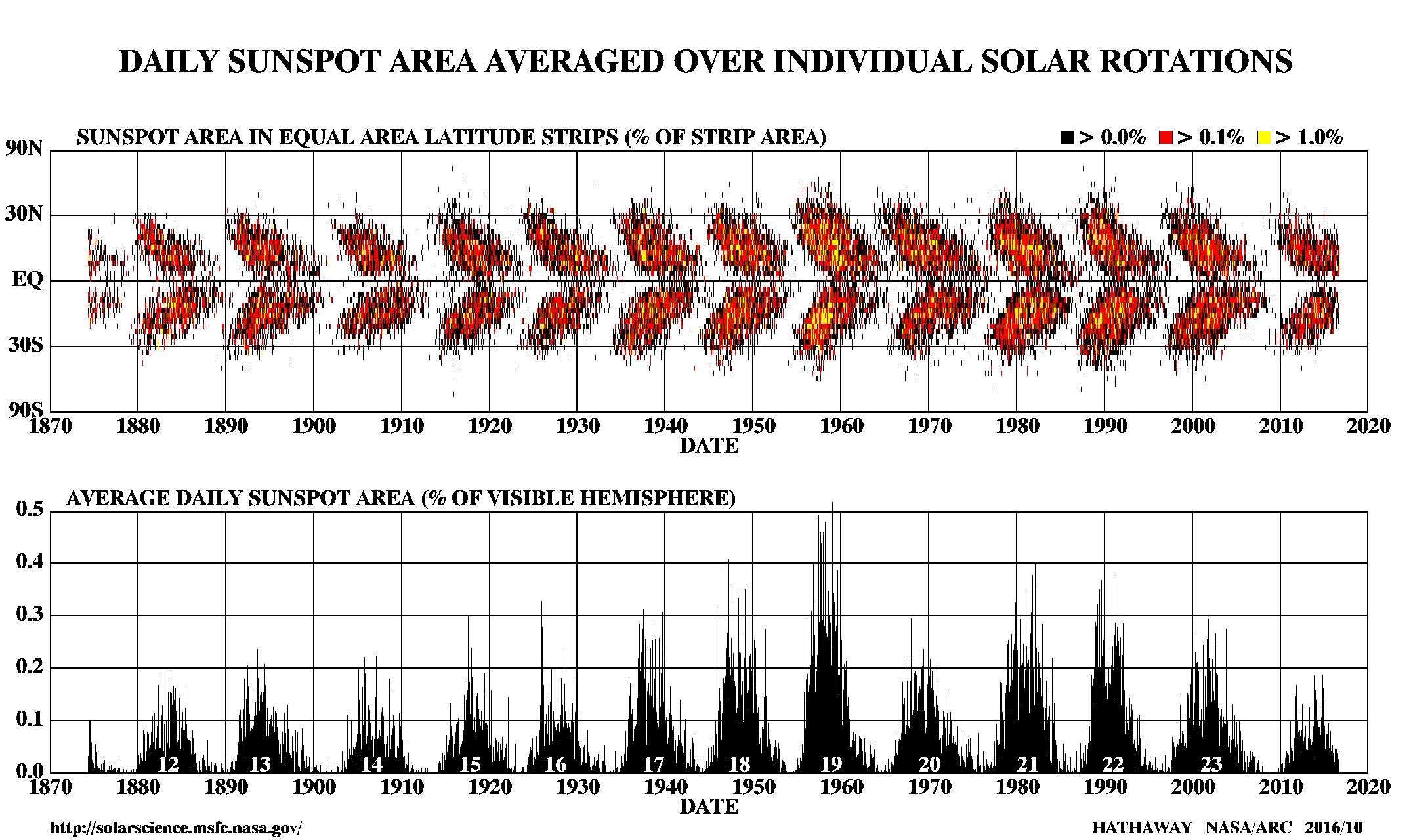 | |
| http://solarscience.msfc.nasa.gov/images/bfly.gif |
I really thought that I had more examples of these - images that are dynamically updated, but that the url for the image stays the same. Now I can't seem to find any more. Anyone know of any others?
April 14, 2014
Thoughts on mindset vs. grit
A recent story on NPR caught my attention. The story is about schools teaching "grit" and whether or not it can be done. My introduction to the concept of grit came from a really great episode of This American Life from 2012. Even though grit is only mentioned by name twice in the episode, there was quite a bit of discussion on non-cognitive traits and their importance to learning. My interest in the episode is summed up best by this line:
"Non-cognitive traits like grit and self-control are even more important in college than in high school."
How best to encourage the best non-cognitive traits leading to success in college? In the NPR piece, Alfie Kohn makes a great point: persistent people persist.
I'm a big believer in the Dweck model of mindsets: fixed vs. growth mindsets. I work to cultivate growth mindsets in my students. It's not easy. It would be great to add grit to my student's toolbox of tools to use for success in college. I watched Duckworth's TED talk hoping she would have some research to present that would be useful for me to use with my students. Here's her TED talk:
If you watched the talk, you may have noticed that the only research cited was Dweck's work on mindset! The talk is over a year old, so maybe there is new work on grit that I'm not aware of.
I spent a lot of time thinking about these questions over the last few weeks. How can mindset be such a solid concept and grit sound great but have easy criticisms?
Leave it to Dr. Tae to answer my questions in less than 140 characters:
"Non-cognitive traits like grit and self-control are even more important in college than in high school."
How best to encourage the best non-cognitive traits leading to success in college? In the NPR piece, Alfie Kohn makes a great point: persistent people persist.
I'm a big believer in the Dweck model of mindsets: fixed vs. growth mindsets. I work to cultivate growth mindsets in my students. It's not easy. It would be great to add grit to my student's toolbox of tools to use for success in college. I watched Duckworth's TED talk hoping she would have some research to present that would be useful for me to use with my students. Here's her TED talk:
If you watched the talk, you may have noticed that the only research cited was Dweck's work on mindset! The talk is over a year old, so maybe there is new work on grit that I'm not aware of.
I spent a lot of time thinking about these questions over the last few weeks. How can mindset be such a solid concept and grit sound great but have easy criticisms?
Leave it to Dr. Tae to answer my questions in less than 140 characters:
Trying to build grit or persistence directly isn't nearly as effective as addressing the mindset that underlies them. http://t.co/AkQTidpOn6
— Dr. Tae (@DrTae) April 2, 2014
Simple, right? There's nothing WRONG with encouraging grit. It's just not as effective as building the growth mindset. Thanks, Tae!
April 10, 2014
Standing on the shoulders of SBG greatness
I've done a lot of reading on the implementation of standards-based grading (SBG) in physics classes. I often tell people I meet that most of the SBG classrooms I know of are in the high schools. I can point to Frank Noschese, Kelly O'Shea, Geoff Schmit, and Shawn Cornally as SBG experts who have successfully used SBG in their classes and share resources online.
Looking online for resources for doing this at the college level has often seemed to turn up fewer resources, at least in my opinion. But, I do want to acknowledge the great SBG users at the college level who have helped me along my way towards using SBG. These include, though are not limited to:
Ian Beatty
Joss Ives
Todd Zimmerman
Andy Rundquist
Rhett Allain
I'm linking above to resources that they have all posted which have helped me start to focus my plans and methods for how I'm implementing SBG in my classes.
Others who I've had great conversations related to SBG include Heather Whitney from Wheaton College, Chris Goedde from DePaul University, and Matt Harding who is a teacher I went to college with. Thanks to all for helping me figure things out. I couldn't have gotten this far without you.
Looking online for resources for doing this at the college level has often seemed to turn up fewer resources, at least in my opinion. But, I do want to acknowledge the great SBG users at the college level who have helped me along my way towards using SBG. These include, though are not limited to:
Ian Beatty
Joss Ives
Todd Zimmerman
Andy Rundquist
Rhett Allain
I'm linking above to resources that they have all posted which have helped me start to focus my plans and methods for how I'm implementing SBG in my classes.
Others who I've had great conversations related to SBG include Heather Whitney from Wheaton College, Chris Goedde from DePaul University, and Matt Harding who is a teacher I went to college with. Thanks to all for helping me figure things out. I couldn't have gotten this far without you.
April 07, 2014
Drafting standards for algebra-based intro physics at a two-year college
Last weekend I was at the Illinois Section AAPT meeting, where I gave a presentation of my foray into Standards-Based Grading. My main points in the presentation were that I have observed:
a.) Most of the people who try SBG the first time write too many standards initially
b.) It's really hard to find a list of standards used in college physics classes online
I've been drafting a set of standards that I would feel comfortable using for a first semester physics class. To address the first point from above, I've whittled it down to 18 standards, although several have multiple parts to them.
I believe that I can assess these standards in chunks of less than 18 assessments. I am aiming for 13-14 nominal assessments with the opportunity for re-assessments on any of them.
I am also working on as-of-yet-unwritten lab standard or standards, which I will likely need help with.
To address the second point from my talk, I'm putting the draft up here for review from the community. I would love to see a discussion of physics faculty from all levels getting involved on building a set of standards that work well. (Not that I want the standards to be, uh....standardized on any level beyond a classroom....)
Here is my draft standards for first semester intro physics, algebra-based. We move oscillations and sound to the second semester, in case you're wondering where they appear. Thank you (in advance) for any thoughts you have on them.
Physics 101 Standards (Draft Spring 2014)
1.) I can interpret and construct graphs of objects in 1-D motion
2.) I can apply a logical problem-solving process to model the motion of objects moving in 1-D.
3.) I can resolve vectors into their components.
4.) I can add and subtract vectors graphically as well as by components.
5.) I can recognize situations described by projectile motion and apply an accurate model of the 2-D motion to determine unknown quantities.
6.) I can apply Newton’s laws of motion for objects in equilibrium as well as objects in motion including:
a.) single objects
b.) connected objects
c.) objects in contact with a spring
d.) objects in circular motion
7.) I can recognize situations where the Work-Kinetic Energy theorem applies, and be able to solve problems using the theorem.
8.) I can recognize situations where the conservation of energy principle is appropriate and be able to apply the principles to those situations including:
a.) objects under the influence of a gravitational field
b.) objects in contact with a stretched or compressed spring
9.) I can identify situations where impulse is used and correctly apply the momentum-impulse theorem.
10.) I can identify situations where conservation of linear momentum is appropriate and correctly apply the conservation principle to those situations including:
a.) elastic collisions
b.) inelastic collisions
11.) I can evaluate (graphically and analytically) the quantities of rotating objects in terms of the linear kinematic equivalents including:
a.) angle
b.) angular velocity
c.) angular acceleration
d.) moment of inertia
12.) I can apply the conservation of energy principle to rotating objects.
13.) I can apply Newton's second law for rotational motion for
a.) objects rotating
b.) objects in static equilibrium
14.) I can identify situations where materials are subject to thermal expansion and be able to calculate the change in their length, area or volume.
15.) I can determine the equilibrium temperature when materials of different initial temperatures are brought into thermal contact with each other.
16.) I can differentiate between conduction, convection and radiation mechanisms.
17.) I can apply the ideal gas law and the results of the kinetic theory of gases to calculate properties of gases.
18.) I can determine the energy transferred by heating required to change the temperature of material and cause materials to change phases.
March 19, 2014
Moving towards standards-based grading
I've been taking baby steps towards standards-based grading (SBG) for over two years, but this semester is the first time that I've really implemented the core ideas of SBG in any of my classes.
Last Fall I had (with my colleague) the opportunity to rewrite learning outcomes for our introductory astronomy course, ASTR101. This is a general education survey of astronomy course without a laboratory. It is 3 credit hours and covers the solar system, stars, and galaxies.
Our campus assessment specialist pushed us to look at the revised Bloom's taxonomy word list to come up with descriptors for what we wanted our outcomes to be. I really don't like how our campus uses the Bloom's taxonomy, but my opinions are a topic for another time.
After the outcomes were written and approved, I realized that I could implement them almost unchanged as standards for a real step towards SBG.
Here's what I did:
I went from 3 exams plus a final to no midterm exams, but nearly weekly quizzes. Each quiz is "scored" on a 0-5 point scale which measures the mastery of the standard being assessed. Students have optional homework assignments on MasteringAstronomy (which, by the way, is NOT optimized for SBG) but they are required to do the homework if they want to re-assess by retaking the quiz. If they want to retake the quiz for a third time, they have to visit my office for a discussion about the standard before they are allowed a third shot. After the third try, the standard is closed.
Grades are weighted - 40% is based on a semester-long astrojournal, 35% is the SBG-style quizzes, 10% is a Just-in-Time-Teaching style reflection/reading review that students submit online, and 15% is a cumulative final.
So far, I've had a fairly positive experience with this in astronomy. I should write down my workflow for getting all the assessments prepared and scored. I have had some students come in for reassessments. I am expecting to see more as the semester progresses.
What I could really use is a bit of feedback on how the standards are written. I can't change the learning outcomes, but I can tweak the standards if appropriate.
There are some standards broken into multiple parts so I could have the option if necessary to break out into multiple assessments. The goal was to have no more than 15-16 assessments. Here's the standards as I wrote them out:
Last Fall I had (with my colleague) the opportunity to rewrite learning outcomes for our introductory astronomy course, ASTR101. This is a general education survey of astronomy course without a laboratory. It is 3 credit hours and covers the solar system, stars, and galaxies.
Our campus assessment specialist pushed us to look at the revised Bloom's taxonomy word list to come up with descriptors for what we wanted our outcomes to be. I really don't like how our campus uses the Bloom's taxonomy, but my opinions are a topic for another time.
After the outcomes were written and approved, I realized that I could implement them almost unchanged as standards for a real step towards SBG.
Here's what I did:
I went from 3 exams plus a final to no midterm exams, but nearly weekly quizzes. Each quiz is "scored" on a 0-5 point scale which measures the mastery of the standard being assessed. Students have optional homework assignments on MasteringAstronomy (which, by the way, is NOT optimized for SBG) but they are required to do the homework if they want to re-assess by retaking the quiz. If they want to retake the quiz for a third time, they have to visit my office for a discussion about the standard before they are allowed a third shot. After the third try, the standard is closed.
Grades are weighted - 40% is based on a semester-long astrojournal, 35% is the SBG-style quizzes, 10% is a Just-in-Time-Teaching style reflection/reading review that students submit online, and 15% is a cumulative final.
So far, I've had a fairly positive experience with this in astronomy. I should write down my workflow for getting all the assessments prepared and scored. I have had some students come in for reassessments. I am expecting to see more as the semester progresses.
What I could really use is a bit of feedback on how the standards are written. I can't change the learning outcomes, but I can tweak the standards if appropriate.
There are some standards broken into multiple parts so I could have the option if necessary to break out into multiple assessments. The goal was to have no more than 15-16 assessments. Here's the standards as I wrote them out:
1) Explain how astronomical objects move in the sky.
2a) Explain the cause of the seasons
2b) Explain the cause of moon phases.
2c) Explain the cause of eclipses.
3) Describe how the heliocentric model of the solar system was developed and why it was adopted over the geocentric model of the universe.
4a&b) Apply Kepler's Laws of orbital motion and Newton's Law of Universal Gravitation to objects in the universe.
5) Describe the functions of a telescope and types of telescopes and explain why some telescopes are placed on the ground and some in space.
6) Explain how astronomers use light to determine:
a.) the luminosity of stars,
b.) temperature of stars,
c.) and size of stars,
d.) chemical composition of astronomical objects,
e.) the speed and direction of an astronomical object's motion,
7) Describe the nature of our solar system and how it was formed.
8) Explain how astronomers use the Hertzsprung-Russell diagram to study properties of stars.
9) Describe how stars are formed, evolve and die.
10) Describe the structure and size of the Milky Way galaxy.
11) Compare the Milky Way galaxy to other galaxies.
12) Explain how astronomers know that the universe is expanding and how they determine the age of the universe.
March 18, 2014
Distances to brightest naked eye stars
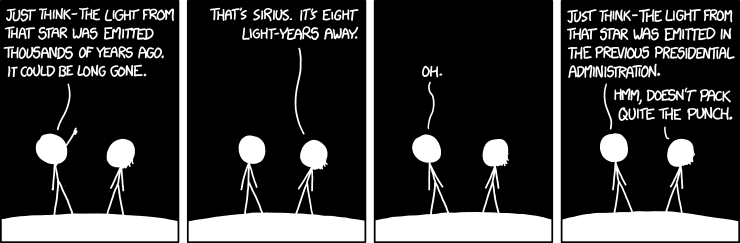
I saw this recent xkcd comic, and had to figure out how many of the naked eye stars are more than 1000 light-years away.
It took me awhile to find a star catalog that was easy to search which also had both the apparent magnitudes and the distances to the stars, but I was able to locate a database of over 87,000 stars in CSV format.
First I found all the stars with magnitude 6.0 or brighter. That narrowed the list down to just over 5,000 stars. Putting the distances into plot.ly, I created this histogram:
Each bar represents a bin of width 100 parsecs. My interest in stars 1000 light-years means I have to look at the stars more than 300 parsecs away. I added up the stars in the first three bins, which represented about 87% of all the visible stars. So my estimate of the naked eye stars which are 1000 light-years away or more is about 13%.
So, assuming on a clear night (no moon, ideal viewing conditions) I could see somewhere between 2000-3000 stars total, only about 250-400 stars would be more than 1000 light years away.
Of course, looking through a telescope changes that figure completely.
March 16, 2014
Suggesting twitter to high school teachers did not go well
Recently I had the opportunity to have dinner with high school science teachers from our college's district. Our department hosted what we call a Science Dinner, which was an open house and a meal after the teachers had a chance to visit labs in the department.
During dinner, the conversation drifted from one topic to the next, including how schools were implementing Next Generation Science Standards, how to implement AP Physics, and the lack of funds for professional development.
I asked the teachers (including a department head) if they had ever thought of exploring online options for professional development such as twitter or facebook. I explained that there are teachers from all over the country on twitter who are asking similar questions and discussing issues which traditional professional development funds would typically cover. I offered to put all the physics teachers in touch with physics teachers on twitter all over the country if they were interested.
The teachers all listened politely and said that they had never considered online professional development. One of them said that another teacher at her school had quit last year over an interaction that happened on social media. Another teacher said that she would never want to be on twitter because her students might be on twitter, and she would not want to interact with them online.
I was stunned at how quickly the conversation turned to pointing out the dark sides of social media. I had this naive idea that interacting with other teachers from around the country would be really attractive. I guess I underestimated the fear of the unknown.
Next time I have the opportunity to plug social media, I'm going to suggest starting with The Global Physics Department first. Perhaps that is an avenue to getting teachers to interact with each other online.
During dinner, the conversation drifted from one topic to the next, including how schools were implementing Next Generation Science Standards, how to implement AP Physics, and the lack of funds for professional development.
I asked the teachers (including a department head) if they had ever thought of exploring online options for professional development such as twitter or facebook. I explained that there are teachers from all over the country on twitter who are asking similar questions and discussing issues which traditional professional development funds would typically cover. I offered to put all the physics teachers in touch with physics teachers on twitter all over the country if they were interested.
The teachers all listened politely and said that they had never considered online professional development. One of them said that another teacher at her school had quit last year over an interaction that happened on social media. Another teacher said that she would never want to be on twitter because her students might be on twitter, and she would not want to interact with them online.
I was stunned at how quickly the conversation turned to pointing out the dark sides of social media. I had this naive idea that interacting with other teachers from around the country would be really attractive. I guess I underestimated the fear of the unknown.
Next time I have the opportunity to plug social media, I'm going to suggest starting with The Global Physics Department first. Perhaps that is an avenue to getting teachers to interact with each other online.
January 07, 2014
What am I trying to encourage with my exam policies?
I'm trying to figure how to handle giving quizzes and exam next semester in my algebra-based physics courses, my intro astronomy course and my general education course in musical acoustics.
There has been much talk online recently about Standards Based Grading (SBG) and related assessment strategies. I'm not diving fully into the SBG waters, and currently my issue isn't directly related to going towards SBG. The reason I mention SBG is to give some context.
Grades in intro physics are made up of the following parts: online reflections of what they did in class and read in the textbook, screencasts done for homework, lab reports, weekly quizzes, midterm exams and a final. I consider the lab reports to be drafts which can be corrected and submitted until they are satisfactory. I also consider the screencast homework assignments to be practice for taking quizzes and exams, so I provide feedback on the screencasts and allow them to be resubmitted as many times as needed until correct.
Quizzes and exams are done in a traditional way - all the students spread out as far away from each other in the classroom and work independently on the quiz or exam for a set amount of time. For quizzes, I provide relevant (and sometimes not-so-relevant) equations, but for the exams students prepare their own equation sheet. I usually give 20 minutes for a quiz and 2 hours for an exam.
But the exams are something else. Again, I have typically given "traditional" type exams where all students work independently. I typically supply equations for these classes.
There is a pattern that is starting to emerge over the last few semesters in astronomy. The first part of the pattern is that on the first exam the class average is somewhere in the mid-60% to mid-70% range. For many students it is shockingly low. However, in the 10-ish years I've been teaching the class, the average on the first exam has never strayed far from this mark. Typically we have a discussion of how now they know how the exam will be structured (even though we discussed it thoroughly beforehand) and that they should think carefully about what changes they need to make in preparing for the next exam. I've also been weighting the first exam less than later exams in recent years to try to alleviate concern that their grade is sunk after one poor exam. The next part of the pattern is that on the second exam (out of three midterm exams) the class average goes down. Significantly down. In most semesters before the last 3, the class average would rise to right below about 80%. More recently, the average has declined to the low 60% range.
Frustrated by this pattern, I offered to allow group exams in astronomy on the third midterm. Working together, the students were able to significantly bring up their scores, although implementing the group exam brings in its own set of challenges in terms of how I score it fairly.
The other related thought that I can't quite decide how to address is the idea that if I want to encourage a type of behavior or thinking, then it SHOULD be a part of the grade somehow.
So for example, last semester in astronomy we used the lecture tutorials by the CAPER team as purely formative assessments. Students were told they would not be graded on them, so they should work together and feel free to make mistakes on them that we would correct in class. My class never fully bought into the idea taking the tutorials seriously as a way of being actively engaged in the class. Even after the first exam had 80% of the questions based directly on the lecture tutorials, and the students themselves recognized how much of the exam was based on the tutorials they did not believe that collaborating with others on the tutorials was necessary.
And why should they have? I was not going to be rewarding them for working with others as a part of their grade, after all. I think that perhaps if group exams were a part of the course from the start, they would have reason to work with others in the class from the beginning.
But, what about the general physics course? I believe Eric Mazur's Harvard course has some form of open-book, open-note policy on quizzes and exams. Others have used group exams in these courses. What am I trying to encourage? I think I am trying to encourage students to work together collaboratively, but am I grading that way? Should I be? Isn't part of the course figuring out how to take quizzes and exams by yourself?
The one idea I've had is to give the exams as take-home exams and allow for students to group up if they want. But instead of them handing in the exam, have them make screencasts for each problem on the exam. That way, I hear each student explain it in their own words, just like the homework. I just don't know if I can grade that many screencasts in a reasonable amount of time.
There has been much talk online recently about Standards Based Grading (SBG) and related assessment strategies. I'm not diving fully into the SBG waters, and currently my issue isn't directly related to going towards SBG. The reason I mention SBG is to give some context.
Introductory Physics Courses
A few years ago when I learned about SBG, I sort of had the wrong idea of how it was supposed to be implemented. I liked the philosophy which allowed for students to learn at their own pace and to be reassessed on understanding of the standards. I also liked the idea of using student-made screencasts (Thanks to Andy Rundquist for leading me down this path) as assessment methods. Because I get to hear the students explain the physics in their own words, I can really find out what they understand and what they are simply regurgitating from class or the book.Grades in intro physics are made up of the following parts: online reflections of what they did in class and read in the textbook, screencasts done for homework, lab reports, weekly quizzes, midterm exams and a final. I consider the lab reports to be drafts which can be corrected and submitted until they are satisfactory. I also consider the screencast homework assignments to be practice for taking quizzes and exams, so I provide feedback on the screencasts and allow them to be resubmitted as many times as needed until correct.
Quizzes and exams are done in a traditional way - all the students spread out as far away from each other in the classroom and work independently on the quiz or exam for a set amount of time. For quizzes, I provide relevant (and sometimes not-so-relevant) equations, but for the exams students prepare their own equation sheet. I usually give 20 minutes for a quiz and 2 hours for an exam.
General education courses - Intro Astronomy and Physics of Sound, Music and Hearing
In the gen ed courses I do not use screencasts. The only homework that the students are required to do is the classroom reflections. Astronomy is not a lab course, so there are no lab reports, but they do have to do a semester-long astronomy journal project. In the acoustics class, students design and build their own musical instrument. I'm pretty happy with those parts of the grading process.But the exams are something else. Again, I have typically given "traditional" type exams where all students work independently. I typically supply equations for these classes.
There is a pattern that is starting to emerge over the last few semesters in astronomy. The first part of the pattern is that on the first exam the class average is somewhere in the mid-60% to mid-70% range. For many students it is shockingly low. However, in the 10-ish years I've been teaching the class, the average on the first exam has never strayed far from this mark. Typically we have a discussion of how now they know how the exam will be structured (even though we discussed it thoroughly beforehand) and that they should think carefully about what changes they need to make in preparing for the next exam. I've also been weighting the first exam less than later exams in recent years to try to alleviate concern that their grade is sunk after one poor exam. The next part of the pattern is that on the second exam (out of three midterm exams) the class average goes down. Significantly down. In most semesters before the last 3, the class average would rise to right below about 80%. More recently, the average has declined to the low 60% range.
Frustrated by this pattern, I offered to allow group exams in astronomy on the third midterm. Working together, the students were able to significantly bring up their scores, although implementing the group exam brings in its own set of challenges in terms of how I score it fairly.
What am I really trying to encourage?
There are some maxims that are sort of swirling around in my head whenever I think about what I'm going to do next semester. One is the saying about how students don't really respond to what you want them to do (or what's best for them) but they will respond to what they are graded on. I guess I can't really think of the exact saying right now, but I think a lot about how to incentivize the intrinsic motivation to pursue deep learning without having to provide the extrinsic motivation of points towards a grade.The other related thought that I can't quite decide how to address is the idea that if I want to encourage a type of behavior or thinking, then it SHOULD be a part of the grade somehow.
So for example, last semester in astronomy we used the lecture tutorials by the CAPER team as purely formative assessments. Students were told they would not be graded on them, so they should work together and feel free to make mistakes on them that we would correct in class. My class never fully bought into the idea taking the tutorials seriously as a way of being actively engaged in the class. Even after the first exam had 80% of the questions based directly on the lecture tutorials, and the students themselves recognized how much of the exam was based on the tutorials they did not believe that collaborating with others on the tutorials was necessary.
And why should they have? I was not going to be rewarding them for working with others as a part of their grade, after all. I think that perhaps if group exams were a part of the course from the start, they would have reason to work with others in the class from the beginning.
But, what about the general physics course? I believe Eric Mazur's Harvard course has some form of open-book, open-note policy on quizzes and exams. Others have used group exams in these courses. What am I trying to encourage? I think I am trying to encourage students to work together collaboratively, but am I grading that way? Should I be? Isn't part of the course figuring out how to take quizzes and exams by yourself?
The real reason I need to figure this out
I have a conference that is going to take me away from school the last week of the semester before finals. I am not happy with this schedule, but there is not much I can do about it right now. What I'd like to do if possible is eliminate in-class exams. Since I typically give three mid-term exams, that effectively gives me back all my time I would be missing at the end of the semester…although it's really never the same. But if I give take-home exams, for example, how should they be structured? Do I explicitly forbid collaboration and trust the students? That seems to go against the classroom dynamic that I would like to foster of students working together. Do I explicitly encourage students to group up and work on it? That would seem to disadvantage students who have busy work and home schedules and cannot easily pop back and forth to campus.The one idea I've had is to give the exams as take-home exams and allow for students to group up if they want. But instead of them handing in the exam, have them make screencasts for each problem on the exam. That way, I hear each student explain it in their own words, just like the homework. I just don't know if I can grade that many screencasts in a reasonable amount of time.
TL;DR
How can I improve the way I assess and evaluate students next term? How closely does the grading policy align with my philosophy on learning and what can I do to improve that?September 04, 2013
The building that melted a Jaguar
Have you heard about the building in London that has been blamed for melting parts of a car by reflecting sunlight off of it? It made the news today and was all over social media.
The first thing I noticed was that the building is curved both horizontally and vertically. I thought it would be interesting to try modeling the building as a spherical mirror and see what I could estimate from this model. Is the building a part of a sphere? Probably not. Is it close enough to use as a model? That's the fun of trying to figure it out.
I found some renderings of the building on its website. I decided to use the 32nd floor to use to estimate the focal length of the horizontally curved part because it looked to be the most curved of all the floor plans in the linked PDF. Here's a screenshot from that file:

You can see the full size image if you click the image. What I liked about the rendering of the floor was that there were dimensions given for the usable office space on the floor. What I didn't like was that there didn't seem to be enough information to directly estimate the radius of a circle defined by the arc of the side of the building. (Maybe I'm wrong about that. It could be an interesting geometry problem. Paging Dan Meyer...) I also didn't like the part about the floor plans not being to scale. I chose to ignore that part. I did like that units were in meters. Because physics.
My plan is to draw a circle so the side of the building follows the edge of the circle. Then, I'll use the dimension given in the image to figure out the size of circle. From that I can get the focal length of a spherical mirror of that size.
Here's what the circle looks like when I put it up to the side of the building:

The blue bar is a rectangle the size of the arrow 20.5 m long in the center of the lower part of the drawing. The red section is the fraction of the circle that I could get into this image. Here's the zoomed out view:

That's a big circle. Let's figure out how big. The blue box when I drew it (in Inkscape, if you're curious) was 431 units (whatever a unit is) long. So the scale is 431 units / 20.5 m or roughly 21.0 units / m.
The circle has a diameter of 10640 units. So the physical diameter of the circle would be 10640 units / 21.0 units / m = 507 m.
The focal length of a spherical mirror is half the radius of the sphere. So the focal length I estimate from this floor is about 127 m.
Looking up the the height of the building gives a value of 180 m, according to Wikipedia and Google, the sources of all knowledge. Figuring out the height of the 32nd floor is not straightforward, but I estimated it to be about 142 meters.
So if the building could somehow reflect the sunlight straight down (which is can't, and doesn't) then according to my rough estimates, the focal length wouldn't be at ground level. This makes me believe the following could all be true:
 |
| Image Credit: Matt Buck |
I found some renderings of the building on its website. I decided to use the 32nd floor to use to estimate the focal length of the horizontally curved part because it looked to be the most curved of all the floor plans in the linked PDF. Here's a screenshot from that file:

You can see the full size image if you click the image. What I liked about the rendering of the floor was that there were dimensions given for the usable office space on the floor. What I didn't like was that there didn't seem to be enough information to directly estimate the radius of a circle defined by the arc of the side of the building. (Maybe I'm wrong about that. It could be an interesting geometry problem. Paging Dan Meyer...) I also didn't like the part about the floor plans not being to scale. I chose to ignore that part. I did like that units were in meters. Because physics.
My plan is to draw a circle so the side of the building follows the edge of the circle. Then, I'll use the dimension given in the image to figure out the size of circle. From that I can get the focal length of a spherical mirror of that size.
Here's what the circle looks like when I put it up to the side of the building:

The blue bar is a rectangle the size of the arrow 20.5 m long in the center of the lower part of the drawing. The red section is the fraction of the circle that I could get into this image. Here's the zoomed out view:

That's a big circle. Let's figure out how big. The blue box when I drew it (in Inkscape, if you're curious) was 431 units (whatever a unit is) long. So the scale is 431 units / 20.5 m or roughly 21.0 units / m.
The circle has a diameter of 10640 units. So the physical diameter of the circle would be 10640 units / 21.0 units / m = 507 m.
The focal length of a spherical mirror is half the radius of the sphere. So the focal length I estimate from this floor is about 127 m.
Looking up the the height of the building gives a value of 180 m, according to Wikipedia and Google, the sources of all knowledge. Figuring out the height of the 32nd floor is not straightforward, but I estimated it to be about 142 meters.
So if the building could somehow reflect the sunlight straight down (which is can't, and doesn't) then according to my rough estimates, the focal length wouldn't be at ground level. This makes me believe the following could all be true:
- The light is reflected off of a lower floor.
- The radius of curvature was underestimated.
- The floor height was overestimated.
- The ground level of the building is lower than where the car was sitting when it got melted.
- I made some other miscalculation.
I'm actually satisfied that I'm on the same order of magnitude for the focal length and the height of the building. If the lower floors (say the 16th) have a larger radius (less curved) and are obviously closer to the ground, then the focal length could easily be longer than the distance from the windows to the ground.
I think this is a neat way to apply some physics to an interesting news story. I have more to think about on this one. For now, I'll have to check and see what Rhett has to say about this building.
August 06, 2013
Video feedback to students
Our campus is going to be transitioning to a new Learning Management System (think Blackboard or Moodle) within the next year-ish. I volunteered to be on the LMS Task Force that is part of the process for selecting the new LMS. This summer I sat through four vendor demos showing off the incredible ways that their systems worked and how great they would be for our campus.
The four that we saw all do the same basic things. There are some faculty on our campus who have specific needs for their courses like grading discussion forums, tying rubrics to certain types of assignments, various uses of calendars and other specific needs. Most of the systems actually seemed (on first glance) to handle most of these needs, although some seemed easier than others to set up and use.
What struck me as something new was that all four of the vendors featured the ability for instructors to provide video feedback to students via the LMS. I mean that it was a prominent part of each of the demos that all of the reps glowed about. I think that all of the video feedback implementations were via screencast, but I think most also weirdly included a recorded webcam session of the instructor talking to the student. I've been assigning students to do screencasts as homework for the past few years now, so I am no stranger to students and instructors communicating via screencast. Depending on the need, I've found it useful to post feedback as a screencast to students, but never my talking head.
I asked some of the reps if the video feature worked for the students to post to the instructor or rest of the class. It was clear that some of the LMSs had the ability, but none of them were intending for that use, which I found a bit disappointing.
So why are so many of these companies showcasing this feature? Are faculty using it? Do students like it? Does it facilitate learning? I feel that I have a pretty good pulse of the physics teaching community, and I don't see anyone using video communication as faculty-to-single-student transmission only. Nor do I have a sense that instructors at my school want that either. But, I could be missing a segment of teachers who find it to be really valuable. If so, I'd be interested in hearing who is using it.
The four that we saw all do the same basic things. There are some faculty on our campus who have specific needs for their courses like grading discussion forums, tying rubrics to certain types of assignments, various uses of calendars and other specific needs. Most of the systems actually seemed (on first glance) to handle most of these needs, although some seemed easier than others to set up and use.
What struck me as something new was that all four of the vendors featured the ability for instructors to provide video feedback to students via the LMS. I mean that it was a prominent part of each of the demos that all of the reps glowed about. I think that all of the video feedback implementations were via screencast, but I think most also weirdly included a recorded webcam session of the instructor talking to the student. I've been assigning students to do screencasts as homework for the past few years now, so I am no stranger to students and instructors communicating via screencast. Depending on the need, I've found it useful to post feedback as a screencast to students, but never my talking head.
I asked some of the reps if the video feature worked for the students to post to the instructor or rest of the class. It was clear that some of the LMSs had the ability, but none of them were intending for that use, which I found a bit disappointing.
So why are so many of these companies showcasing this feature? Are faculty using it? Do students like it? Does it facilitate learning? I feel that I have a pretty good pulse of the physics teaching community, and I don't see anyone using video communication as faculty-to-single-student transmission only. Nor do I have a sense that instructors at my school want that either. But, I could be missing a segment of teachers who find it to be really valuable. If so, I'd be interested in hearing who is using it.
August 05, 2013
Does Khan Academy listen to content experts?
Christopher Danielson has an Open Letter to Sal Khan which has stirred up some discussion recently. When I read his piece I was drawn to this part in the middle:
"Mr. Khan, you have a team of teacher advisors. If none of them can identify these gaps for you, you need to ask for help from the larger community (and then to reexamine your hiring practices)."
Out of all the criticisms of the Khan Academy, this is the one that upsets me the most. That KA in general, and Sal Khan personally, cannot find it in themselves to reach out to the education community to improve their offering indicates to me that they must not care about having high quality resources on their site, only that they care about having a high quantity of resources.
Over a year ago, I posted my critique of the stellar parallax videos. In my critique I pointed out several (at least four) things that I thought were really good about the explanations of parallax. But, I also pointed out some huge problems with the videos, including the incorrect depiction of the night sky showing East and West directions reversed (starting at about the 8:40 mark in my video). Apparently, Sal Khan does not know which way East and West go. None of the videos on parallax have been changed in the past year.
I realize that I'm just one guy, and maybe KA has no reason to listen to me. (Sal has yet to take me up on my offer to have him talk with us at the Global Physics department or an AAPT conference.) I have taught intro astronomy at least 20 times and we usually spend an hour or two of class time on parallax not including review time or out of class discussions that I have with students. I have invested at least as much time prepping for teaching these classes, so I have at least 40 hours of experience in teaching this topic alone. I know there are teachers out there with even more experience than that, and I am constantly looking to learn from them. When I learn a better way to teach a topic, I alter my approach. Why isn't the same true for KA?
I pointed out above that in my critique of the parallax videos I thought there were some pretty good things about them, including at least one part of the explanation that was unique (and accurate) and I hadn't seen anywhere else. I'm pointing this out again in part because I'm not interested in rehashing any of the tired arguments that supporters of KA bring up over and over again.
Let's talk about how KA can engage with great educators at all levels so that we can all get better at what we are trying to do. Some of the KA staff do engage with others in discussions, but they sometimes miss the point. In the Hacker News discussion that I linked to above Ben from KA says this:
"It's difficult for us to work through all of the submitted issues because most of them are from students who don't understand the problem or have made a mistake in their work, not real issues with the content. We always keep an eye on the number of issues per exercise, and we're lucky to have volunteers who read through the issues and surface the real issues."
To be fair, Ben is talking about responding to issues related to homework-like problems on KA. But, his statement reveals the heart of the problem with what KA is trying to do: engaging learners in a meaningful way using algorithmic methods doesn't always (often?) work. I would argue this must be especially true for conceptual learning, which is the root of deep understanding in most topics.
August 01, 2013
New tag in Evernote: Show-to-students
I have a new tag in Evernote I called it Show-to-students. I have tagged everything clipped recently from the web that I want my students in the Fall (and semesters after) to read. These are articles, essays and blog posts which highlight ideas I think are important for the learning process. I'm sure I found all of these via my twitter stream, so I want to thank you all for posting them to twitter, whoever you were.

So far, I have five items to share with my classes.
The most recent one that I found is the excellent post on ConvergeDiverge about the teaching philosophy that Maxwell had. I think Heather has a great insight that we as instructors have a struggle with some (or many) of our students between how deeply they want to think about the topics we would like them to think about. As my comment (and Heather's reply) indicate, I think it could be helpful to address this issue at the start of the class as a part of setting the tone and expectations for the class early.
Another article that I'd like to share with my class is the article from Slate on the inability of students to effectively multitask. The article includes this nugget:
During the first meeting of his courses, Rosen makes a practice of calling on a student who is busy with his phone. “I ask him, ‘What was on the slide I just showed to the class?’ The student always pulls a blank,” Rosen reports. “Young people have a wildly inflated idea of how many things they can attend to at once, and this demonstration helps drive the point home: If you’re paying attention to your phone, you’re not paying attention to what’s going on in class.”I don't know if I could execute that move in class unless I've told the class to read this article in advance. I'd also consider using Patrick Len's excellent approach to cell phone / social media use in class: poll the class and use the class discussion to set the cell phone / social media policy. But really, I just want students to be thinking about how much they can actually learn while they are trying to multitask.
When I looked at my tagged articles, there was a surprising pattern I had not expected: three of the five articles were about the role of failure in learning. I must have been channeling a certain skateboarding physicist when I was tagging these articles. "Failures, Mistakes and Other Learning Tools" was a blog post that sat in one of my browser tabs for MONTHS last year. I was really inspired by how this teacher handled his student's confrontation with failure for the first time. The blog post on Scientific American which told the story of Feynman's attitude toward being wrong in science should be mandatory reading for all future scientists. Then there is this incredibly honest piece on Slate by a math teacher on what it was like for him to have been "bad at math" and how that experience ultimately made him a better teacher. I'd like to connect that idea to the growth mindset that Dweck writes about in her book.
I saw a question on Quora that also connected failure with learning. It was good, but I'm not sure if I'm going to add it to the list. I might just leave my students with Adam Savage's catch phrase: Failure is always an option.

July 31, 2013
Toothpick / matchstick lab idea
Since I am going to use the "Measure the value of pi" lab for introducing graphing, equation editors and potentially writing a lab report, I want to have a lab where the goals and the experimental procedure is developed by the students in the class from top to bottom as much as possible. Here's my idea:
I plan to give students a taped box of matches or toothpicks with a random number of matchsticks or toothpicks in them. Alternatively, I could have a single full box that students could have with the ability to put as many or as few matchsticks or toothpicks in as they choose. Hmmm….going to have to think about that one.
There will be only one rule: students cannot open any box until the lab is done and the report is written.
I'm going to ask students: What do you want to know about the box? I want them to write their questions down before they say anything. Then I'll have them discuss in small groups with whiteboards. Then we'll have a short all-class discussion of the questions they are interested in.
I am hoping that the groups will come up with at least "How many matchsticks (or toothpicks) are in my box?" But I would also be thrilled if they came up with questions like "What is the mass of a single matchstick (or toothpick)?" and "What is the mass of the box (and tape)?" These are my goals for the lab, it will be interesting to see what the class comes up with. If needed, we can have a discussion which leads us to these goals.
I will have prepared ahead of time several identical boxes each with a unique number of matchsticks or toothpicks in them and marked on the box itself. I will try to use the same amount of tape on each box, so each box is as identical as possible.
This is the first lab where I will encourage the students determine the process by which they will meet the goals of the lab. I don't know if it's the best way to encourage this process, but it should be a good follow up to the pi lab. I don't think there are many ways to find the mass of a single matchstick or toothpick, the mass of the box and the unknown number in the initial box, other than using a linear fit model, but I'll leave the students to figure that out.
I want to have students make predictions or guesses for the quantities they want to measure before doing the lab. I think it will be interesting to see how these guesses compare to the experimental data. We can have some discussions about orders of magnitude if there are wildly varying guesses.
Then we'll do the lab. I tried this myself and it went really quickly. There's not much to do other than mass the boxes and record the data.

I want to make sure every student has a graph of the data and has used equation editor to express their best fit line equation. If time permits, I want to have them start to write the lab report.
My worry with this lab is again that it is too easy. I hope that by emphasizing the students' control of the goals and procedure it will hold their attention to the end of the lab. Plus, if we finish early, I have an idea for the next lab to do. :-)
I plan to give students a taped box of matches or toothpicks with a random number of matchsticks or toothpicks in them. Alternatively, I could have a single full box that students could have with the ability to put as many or as few matchsticks or toothpicks in as they choose. Hmmm….going to have to think about that one.
There will be only one rule: students cannot open any box until the lab is done and the report is written.
I'm going to ask students: What do you want to know about the box? I want them to write their questions down before they say anything. Then I'll have them discuss in small groups with whiteboards. Then we'll have a short all-class discussion of the questions they are interested in.
I am hoping that the groups will come up with at least "How many matchsticks (or toothpicks) are in my box?" But I would also be thrilled if they came up with questions like "What is the mass of a single matchstick (or toothpick)?" and "What is the mass of the box (and tape)?" These are my goals for the lab, it will be interesting to see what the class comes up with. If needed, we can have a discussion which leads us to these goals.
I will have prepared ahead of time several identical boxes each with a unique number of matchsticks or toothpicks in them and marked on the box itself. I will try to use the same amount of tape on each box, so each box is as identical as possible.
This is the first lab where I will encourage the students determine the process by which they will meet the goals of the lab. I don't know if it's the best way to encourage this process, but it should be a good follow up to the pi lab. I don't think there are many ways to find the mass of a single matchstick or toothpick, the mass of the box and the unknown number in the initial box, other than using a linear fit model, but I'll leave the students to figure that out.
I want to have students make predictions or guesses for the quantities they want to measure before doing the lab. I think it will be interesting to see how these guesses compare to the experimental data. We can have some discussions about orders of magnitude if there are wildly varying guesses.
Then we'll do the lab. I tried this myself and it went really quickly. There's not much to do other than mass the boxes and record the data.

I want to make sure every student has a graph of the data and has used equation editor to express their best fit line equation. If time permits, I want to have them start to write the lab report.
My worry with this lab is again that it is too easy. I hope that by emphasizing the students' control of the goals and procedure it will hold their attention to the end of the lab. Plus, if we finish early, I have an idea for the next lab to do. :-)
July 30, 2013
First lab of the year - crawling before walking before running
There was a day last semester in the algebra based physics class (mechanics and thermo) towards the end of the semester when one of my students through up his hands and complained: "How am I supposed to know how to make a graph in Excel when you never taught us how?!"
On the one hand, my thoughts were that they had been writing and turning in lab reports all semester which were supposed to have had graphs on them, plus this being a college class I figured that either they would 1.) know how make a graph or 2.) ask me for help without getting frustrated.
On the other hand, my thought was the student had a point: I had not done anything with making graphs.
Another shortcoming that many of the students I see have is never having used the equation editor in Word (or even having heard of TeX).
This Fall, I'm going to go back to one of my old favorite first labs and make it a learn to graph / introduction to equation editor / introduction to linear fits and the practice of writing a lab report exercise.
The lab is a "Measurement of Pi" lab where students are given a bunch of circular objects and asked to experimentally determine pi. The past few times I've run this lab, I've used it more to introduce the idea that students should be able to design their own experimental techniques in lab to meet whatever goal I choose (or ideally, whatever goals the students choose.) While I think this is an important lesson for intro physics (for engineers or not), I think I can de-emphasize the design part a bit if we use the lab to introduce some important techniques to be used throughout the lab.
So, here's my vision:
So there's a lot for students to digest here: graphs, best fit, uncertainty, equation editor, lab report writing.
How much class time can we devote to this? I'm not going to spend more than a 2-hour block on this, especially since I want to do a lab where the students are more in charge of the design of the experimental procedure and analysis. (More on that idea soon!)
My fear is that we as a class will not manage the time appropriately on the first day. I want to do FCI on the first day as well as breezing through the syllabus. Then, if I hit them with this lab, well, it might be a lot. On the other hand….the concept at it's core is really simple: we're going to make a graph of circumference vs diameter. So, maybe it won't be too bad. As a backup, I will have the followup labs ready to go in case the class finishes really early.
On the one hand, my thoughts were that they had been writing and turning in lab reports all semester which were supposed to have had graphs on them, plus this being a college class I figured that either they would 1.) know how make a graph or 2.) ask me for help without getting frustrated.
On the other hand, my thought was the student had a point: I had not done anything with making graphs.
Another shortcoming that many of the students I see have is never having used the equation editor in Word (or even having heard of TeX).
This Fall, I'm going to go back to one of my old favorite first labs and make it a learn to graph / introduction to equation editor / introduction to linear fits and the practice of writing a lab report exercise.
The lab is a "Measurement of Pi" lab where students are given a bunch of circular objects and asked to experimentally determine pi. The past few times I've run this lab, I've used it more to introduce the idea that students should be able to design their own experimental techniques in lab to meet whatever goal I choose (or ideally, whatever goals the students choose.) While I think this is an important lesson for intro physics (for engineers or not), I think I can de-emphasize the design part a bit if we use the lab to introduce some important techniques to be used throughout the lab.
So, here's my vision:
- Get students into groups. Each group gets a single circle but all circles will be of different size.
- Ask students to think of what quantities they could measure with the circles. Have them whiteboard these ideas, then share with the rest of class.
- If no group comes up with value of pi for answer, ask if there is a quantity which is fundamental to all the circles, regardless of size.
- Ask groups to come up with a way of measuring pi. Have them whiteboard it and share with rest of class.
- Have a discussion of the difference between experimental uncertainty and error as well as taking an average vs. creating a graph with linear fit.
- Each student makes a graph of the class data. We include error bars and a linear fit.
So there's a lot for students to digest here: graphs, best fit, uncertainty, equation editor, lab report writing.
How much class time can we devote to this? I'm not going to spend more than a 2-hour block on this, especially since I want to do a lab where the students are more in charge of the design of the experimental procedure and analysis. (More on that idea soon!)
My fear is that we as a class will not manage the time appropriately on the first day. I want to do FCI on the first day as well as breezing through the syllabus. Then, if I hit them with this lab, well, it might be a lot. On the other hand….the concept at it's core is really simple: we're going to make a graph of circumference vs diameter. So, maybe it won't be too bad. As a backup, I will have the followup labs ready to go in case the class finishes really early.
July 03, 2013
Back in the (scientific) python business!

The above five lines of python represent the accomplishment of a (small) summer goal of mine: to have one cohesive python install with all of my favorite python packages for writing code for physics classes and research.
I don't know what happened earlier this year, but I had b0rked up my python install on my school laptop. I have a Macbook Pro, and was running into all sorts of problems: 32 bit vs. 64 bit, which install of python to use and whether or not I could use matplotlib and vpython at the same time.
What I ended up with was two installs of python: one that could use vpython and one that could use matplotlib, but never the two at the same time.
As you can see in the screenshot, I have everything working now with the excellent enthought distribution of python. What I learned today was that ALL the packages in the vpython dmg file are required to run vpython. I don't remember my original thought process which led me to believe I didn't need the other packages, but I did. Also, I learned today that you can't always (simply) run vpython calls from the python shell, unless you limit the rate of displaying frames by putting rate() inside a loop. More on that later, maybe.
I know the above packages have significant overlap (scipy extends numpy, pylab has matplotlib, etc.) but I've used each of those in various forms, so I wanted to be able to call any of them without having to THINK about it. Done.
Okay, so if you made it this far into this post, you deserve a reward. How about 8 tutorials on scientific python programming? My favorites are the SciPy tutorial and the excellent matplotlib tutorial.
June 26, 2013
School year 2012-13 reflections
I had my annual review with my dean yesterday. It went well, and although I don't have much to say about the review specifically, it was a time to reflect on things that went well and not so well in class this past year.
What I've come up with are things that I'm going to try in order to build on what has been going well and correct things that are not going so well:
I'm really happy with how the last year turned out. I am looking forward to the Fall, but really happy to have the Summer to prepare for it.
What I've come up with are things that I'm going to try in order to build on what has been going well and correct things that are not going so well:
- I'm going to completely change how I assign what I call "Reading Reviews". This is probably going to be my biggest change next year, and I plan to have a separate post on this topic soon.
- Lab report first drafts are going to be due the next class period we meet after the lab has been completed. Part of the point of a science course should be to model good scientific processes. I am terrible at quickly writing up scientific work that I do. But, if I want my students to start forming good habits, then we need them to write up what they do in lab as quickly as possible. That way there is less time for the memory of what was done in lab to fade. I will continue to use the policy of allowing as many rewrites as needed to get full credit on the lab.
I saw that Joss posted about his concerns about lab report revisions on twitter today:I love using revise until correct but spend too much time worrying about Ss shooting themselves in the foot without constant deadlines
That's a concern I have, too, but ultimately the responsibility is on the student to meet the expectations put forth in the syllabus.
— Joss Ives (@jossives) June 25, 2013 - I give a lot of short quizzes the first part of the semester, hopefully to encourage preparation for exams. I am planning to grade the quizzes in class as soon as they are done. We use a studio physics classroom, which makes for long class periods (at least 2 hours), and since I see my role as a facilitator of the learning environment rather than a lecturer, I will need to have mostly self-directed tasks for the class to work on for the 20ish minutes it will take to score all the quizzes. My goal is to have the immediate feedback encourage the students to come to class better prepared for quizzes and exams. Even though I'm not using standards-based grading specifically, I am striving towards keeping the spirit of SBG. (Excellent post by Frank Noschese.)
- Based on what I learned at the New Faculty Experience, I will be trying to make more frequent reflections. I started doing this late in the year using Evernote. Part of my problem with doing it regularly was that I had a tight schedule last semester. In the Fall I won't have that issue.
I'm really happy with how the last year turned out. I am looking forward to the Fall, but really happy to have the Summer to prepare for it.
June 24, 2013
Musical Acoustics Research Library online!
If you're interested in the field of musical acoustics you'll definitely want to check out this resource from Stanford: the Musical Acoustics Research Library.
I found out about MARL when I received an email with this press release. The collection is broken up into four parts: a collection of material from the Catgut Acoustical Society, and collections of materials from three well-known acousticians.
Much of the material has been digitized, allowing anyone to peruse the correspondence between colleagues, drafts of articles and the ephemera contained in the collection.
According to this post, the collection is completely digitized, but there seems to be some parts which are not available online. I'm not sure if that's due to copyright, or if there are plans to post the rest of the collection online in the future. In any case, what is online right now is a great resource for musical acoustics and also a neat look into how scientists collaborated with each other from the 1960s through the late 1980s and 1990s.
I found out about MARL when I received an email with this press release. The collection is broken up into four parts: a collection of material from the Catgut Acoustical Society, and collections of materials from three well-known acousticians.
Much of the material has been digitized, allowing anyone to peruse the correspondence between colleagues, drafts of articles and the ephemera contained in the collection.
According to this post, the collection is completely digitized, but there seems to be some parts which are not available online. I'm not sure if that's due to copyright, or if there are plans to post the rest of the collection online in the future. In any case, what is online right now is a great resource for musical acoustics and also a neat look into how scientists collaborated with each other from the 1960s through the late 1980s and 1990s.
the John
W. Coltman Collection, the Arthur H. Benade Collection, and the John
Backus Collection. - See more at:
http://library.stanford.edu/blogs/special-collections-unbound/2013/04/musical-acoustics-research-library-records-digitized#sthash.bQVLskwV.dpuf
the John
W. Coltman Collection, the Arthur H. Benade Collection, and the John
Backus Collection. - See more at:
http://library.stanford.edu/blogs/special-collections-unbound/2013/04/musical-acoustics-research-library-records-digitized#sthash.bQVLskwV.dpuf
the John
W. Coltman Collection, the Arthur H. Benade Collection, and the John
Backus Collection. - See more at:
http://library.stanford.edu/blogs/special-collections-unbound/2013/04/musical-acoustics-research-library-records-digitized#sthash.bQVLskwV.dpuf
the John
W. Coltman Collection, the Arthur H. Benade Collection, and the John
Backus Collection. - See more at:
http://library.stanford.edu/blogs/special-collections-unbound/2013/04/musical-acoustics-research-library-records-digitized#sthash.bQVLskwV.dpuf
the John
W. Coltman Collection, the Arthur H. Benade Collection, and the John
Backus Collection. - See more at:
http://library.stanford.edu/blogs/special-collections-unbound/2013/04/musical-acoustics-research-library-records-digitized#sthash.bQVLskwV.dpuf
the John
W. Coltman Collection, the Arthur H. Benade Collection, and the John
Backus Collection. - See more at:
http://library.stanford.edu/blogs/special-collections-unbound/2013/04/musical-acoustics-research-library-records-digitized#sthash.bQVLskwV.dpuf
the John
W. Coltman Collection, the Arthur H. Benade Collection, and the John
Backus Collection. - See more at:
http://library.stanford.edu/blogs/special-collections-unbound/2013/04/musical-acoustics-research-library-records-digitized#sthash.bQVLskwV.dpuf
the John
W. Coltman Collection, the Arthur H. Benade Collection, and the John
Backus Collection. - See more at:
http://library.stanford.edu/blogs/special-collections-unbound/2013/04/musical-acoustics-research-library-records-digitized#sthash.bQVLskwV.dpuf
the John
W. Coltman Collection, the Arthur H. Benade Collection, and the John
Backus Collection. - See more at:
http://library.stanford.edu/blogs/special-collections-unbound/2013/04/musical-acoustics-research-library-records-digitized#sthash.bQVLskwV.dpuf
the John
W. Coltman Collection, the Arthur H. Benade Collection, and the John
Backus Collection. - See more at:
http://library.stanford.edu/blogs/special-collections-unbound/2013/04/musical-acoustics-research-library-records-digitized#sthash.bQVLskwV.dpuf
June 14, 2013
Github for science: anyone played with these yet?
If you've written any amount of code beyond "Hello, world" you are probably familiar with the idea of version control systems. The idea is simple: you use a piece of software to keep track of changes that you've made to your code. If you are working on a complex project involving multiple people, using a VCS is likely the only way to efficiently manage the project.
If you're working on a project with a collaborator, there is no need to be in the same location as each other if you are both able to access the shared space where your files can be indexed by the VCS. Most VCS make it trivial to work with others via cloud-based services.
One VCS that is popular is called git. There is a web service called GitHub where coders who use git can check-in their code and collaborate with others. And, although there are people and organizations starting to use GitHub for non-software projects, there are GitHub-like clones popping up for specialized fields.
Two in particular have caught my eye for scientific research projects: SciGit and Banyan. Both of these sites are pretty new, and they both seem to have roughly the same idea: a service for scientists to collaborate on projects with version control without having to learn a lot about git itself.
I'm interested to know if anyone out there has looked at these sites or tried them out.
If you're working on a project with a collaborator, there is no need to be in the same location as each other if you are both able to access the shared space where your files can be indexed by the VCS. Most VCS make it trivial to work with others via cloud-based services.
One VCS that is popular is called git. There is a web service called GitHub where coders who use git can check-in their code and collaborate with others. And, although there are people and organizations starting to use GitHub for non-software projects, there are GitHub-like clones popping up for specialized fields.
Two in particular have caught my eye for scientific research projects: SciGit and Banyan. Both of these sites are pretty new, and they both seem to have roughly the same idea: a service for scientists to collaborate on projects with version control without having to learn a lot about git itself.
I'm interested to know if anyone out there has looked at these sites or tried them out.
June 12, 2013
Science Hall, Goshen College - 1947-53
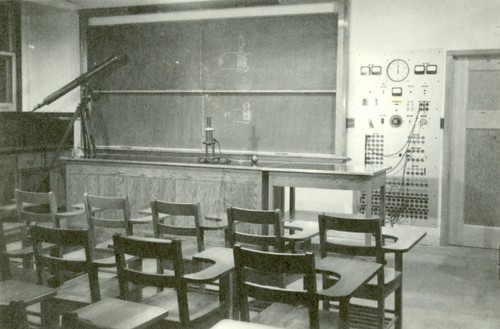

This photo was taken sometime between 1947 and 1953, according to the information on flickr.
How many physics (and/or science) classrooms look the same 60 years later?
At least we don't use the giant built-in power supplies anymore.
Via Flickr:
Caption: April, 1948. Goshen, Indiana. Interior scene in Physics Lab in Science Hall, Goshen College.
Citation: Mennonite Community Photograph Collection, 1947-1953. Goshen College. HM4-134 Box 2 Photo 301-9. Mennonite Church USA Archives - Goshen. Goshen, Indiana.
Subscribe to:
Posts (Atom)